Executive Summary
The Study and Learn agent is now generally available in US English for Microsoft 365 Copilot across all primary education license tiers (A1, A3, A5) without requiring secondary premium licensing add-ons. It is engineered from learning science benchmarks to act as an active coach that intentionally utilizes productive struggle, prompting users to work through problem steps themselves rather than spitting out answers verbatim.
Deployment within student clusters requires IT administrators to manually adjust core tenant parameters. For student accounts between the ages of 13 and 17, administrators must explicitly enable Copilot Chat. Once this foundational access layer is flipped on via Microsoft's policy panels, the specialized Study and Learn agent seamlessly aggregates inside the application's left navigation rail.
The companion Learning Activities infrastructure operates as a unified space via a standalone web dashboard (aka.ms/learningactivities). Educators can copy static content pools or documents into the module to generate modular flashcards, fill-in-the-blank routines with automated distraction answers, and gamified matching boards that embed live leaderboard metrics for structured classrooms.
Key Takeaways
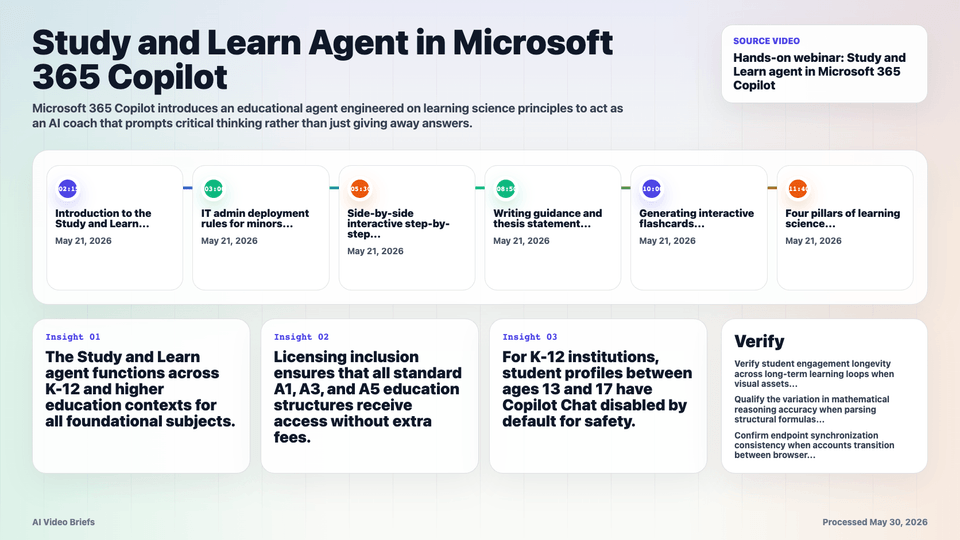
- The Study and Learn agent functions across K-12 and higher education contexts for all foundational subjects.
- Licensing inclusion ensures that all standard A1, A3, and A5 education structures receive access without extra fees.
- For K-12 institutions, student profiles between ages 13 and 17 have Copilot Chat disabled by default for safety.
- The system prompt architecture is explicitly designed to refuse writing complete essays or thesis statements directly for students.
- Cloud file ingestion supports generating multi-modal practice items from Word, PowerPoint, PDF, and Excel documents.
- Data sovereignty controls guarantee that user information remains confined to the tenant and is never mined to train base LLMs.
Builder Implications
- Build cognitive scaffolding routines into consumer AI engines to favor step-by-step Socratic querying over direct problem resolution.
- Implement systemic content boundaries that steer text generation from executing full writing requests into building conceptual outlines.
- Structure multi-tier access gateways that automatically filter interactive elements based on user age telemetry and tenant flags.
- Leverage vector indexing techniques to cleanly separate synthetic distraction choices from valid ground-truth target phrases.
- Ensure full data lifecycle encapsulation in corporate multi-tenant schemas to uphold compliance across strict public policy sectors.
Things to Verify
- Verify student engagement longevity across long-term learning loops when visual assets load as inline canvas cards.
- Qualify the variation in mathematical reasoning accuracy when parsing structural formulas from uploaded whiteboard photos.
- Confirm endpoint synchronization consistency when accounts transition between browser engines and desktop clients across diverse locales.