Executive Summary
The episode frames frontier AI training as a worst-case workload for conventional data-center networks. Web infrastructure can tolerate independent flows and average-case smoothing, but synchronous GPU training behaves like one tightly coupled machine: the slowest worker or congested path can hold back the whole run.
Multi-Path Reliable Connection, or MRC, is presented as OpenAI's answer to that bottleneck. Instead of depending on active routing protocols to discover failures and converge over seconds, MRC pushes path choice and failure response to endpoints, sprays packets over many paths, and uses packet trimming to signal congestion quickly.
The larger infrastructure message is that AI supercomputers need co-design across models, workload software, network adapters, switches, and standards. OpenAI positions MRC as an open Ethernet-based path through OCP so the supply chain can converge around interoperable hardware rather than one proprietary fabric.
Key Takeaways
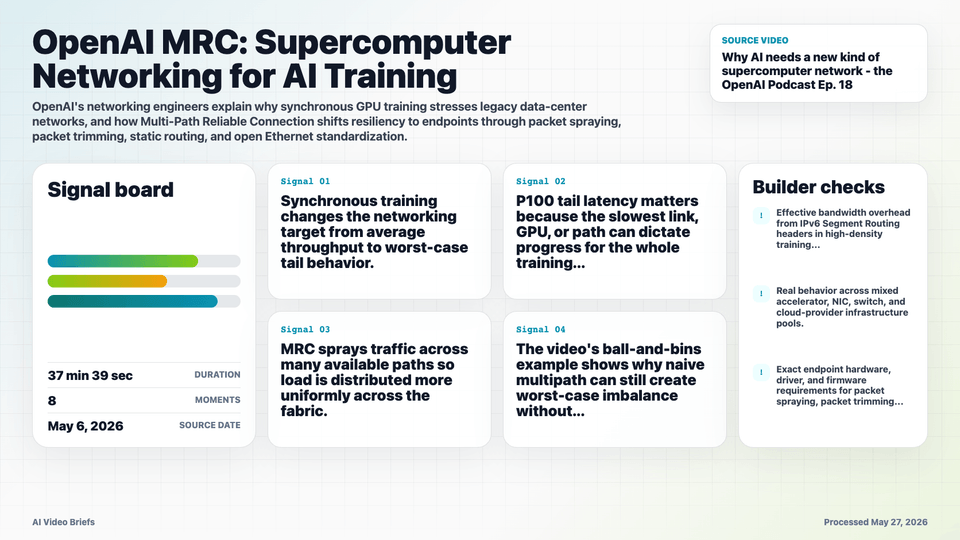
- Synchronous training changes the networking target from average throughput to worst-case tail behavior.
- P100 tail latency matters because the slowest link, GPU, or path can dictate progress for the whole training job.
- MRC sprays traffic across many available paths so load is distributed more uniformly across the fabric.
- The video's ball-and-bins example shows why naive multipath can still create worst-case imbalance without deliberate endpoint control.
- Packet trimming gives endpoints an explicit congestion signal by forwarding the header while dropping the payload.
- Moving failure detection to endpoints can reduce recovery from BGP-style convergence times to millisecond-scale decisions.
- Static routing tables reduce switch control-plane complexity, making the fabric more deterministic at large scale.
- Flatter network topologies can reduce switch layers, capital cost, and power draw when packet distribution is uniform.
- Open standardization through OCP is positioned as a way to align vendors including Microsoft, NVIDIA, Broadcom, AMD, and Intel.
Builder Implications
- Profile distributed systems by tail latency and synchronization stalls, not only aggregate bandwidth.
- Prefer decentralized recovery paths when central control-plane convergence would pause the whole workload.
- Design infrastructure and software together; model scale, collective communication, NIC behavior, and switch topology are coupled.
- Use open standards where possible to reduce vendor lock-in and preserve hardware supply-chain flexibility.
- For large clusters, power efficiency is part of model capacity: fewer unnecessary switch layers can leave more watts for accelerators.
Things to Verify
- Effective bandwidth overhead from IPv6 Segment Routing headers in high-density training workloads.
- Real behavior across mixed accelerator, NIC, switch, and cloud-provider infrastructure pools.
- Exact endpoint hardware, driver, and firmware requirements for packet spraying, packet trimming, and rapid rerouting.
- Operational limits of boot-time static routing tables as cluster size and network diameter grow.
- Failure behavior during correlated outages where many links or devices fail at once.