Executive Summary
The episode presents life sciences as a domain where general AI needs both deeper specialization and stronger operational scaffolding. OpenAI describes a life sciences model series, a research plugin with domain skills, and agentic workflows that combine language reasoning with structure prediction, literature analysis, and reproducible execution environments.
The practical product direction is not a standalone chatbot that magically does biology. The speakers describe AI systems acting more like computational biologists: calling external tools, coordinating many parallel subtasks, generating interactive artifacts, and eventually connecting protocols to robotic lab execution in carefully controlled environments.
Biosecurity is treated as a core product constraint. Early biological workflows can look similar whether the intent is therapeutic or dangerous, which makes broad access hard to manage by prompt text alone. The proposed path is differentiated access: verified organizations, traceable reagents and cell lines, and controls that preserve useful capability for legitimate labs.
Key Takeaways
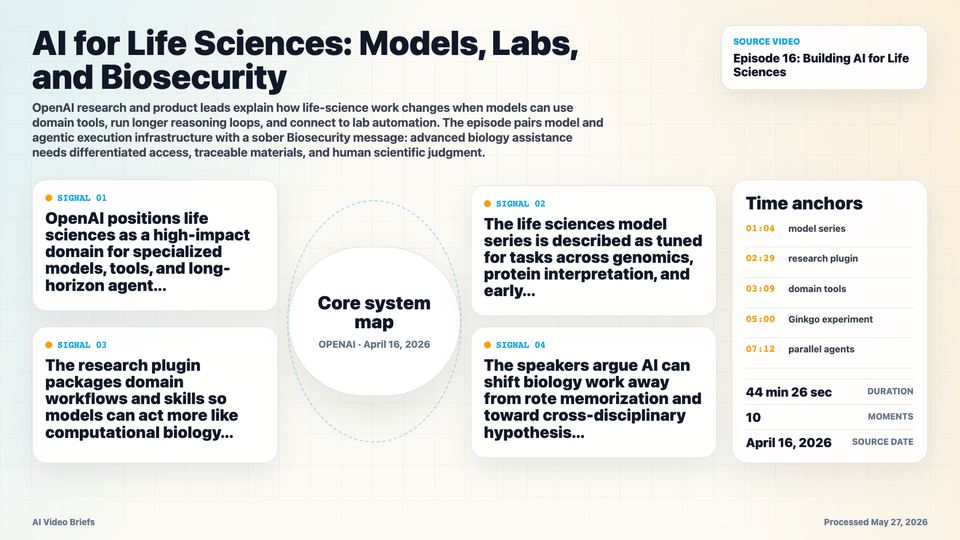
- OpenAI positions life sciences as a high-impact domain for specialized models, tools, and long-horizon agent workflows.
- The life sciences model series is described as tuned for tasks across genomics, protein interpretation, and early discovery workflows.
- The research plugin packages domain workflows and skills so models can act more like computational biology assistants.
- The speakers argue AI can shift biology work away from rote memorization and toward cross-disciplinary hypothesis generation.
- Labs can start with low-lift AI help, such as explaining dense PDFs or generating routine dilution spreadsheets, before deeper automation.
- Tool use matters: structure prediction and analysis tools are part of the system rather than something the base model should simulate unaided.
- The Ginkgo Bioworks collaboration is an early wet-lab benchmark, not evidence of end-to-end autonomous drug discovery.
- Parallel agent orchestration is framed as a way to reduce human execution bottlenecks in scientific workflows.
- Test-time compute is presented as a lever for giving models longer reasoning horizons on difficult biology problems.
- Biosecurity constraints are not incidental; they shape access tiers, refusal behavior, tracking, and product design.
- Differentiated access is meant to help professional researchers avoid unnecessary refusals while keeping dangerous capability gated.
- The long-range vision is an autonomous lab where human scientists set direction and AI-connected systems execute and validate experiments.
Builder Implications
- Build biology tools as orchestrated systems with model reasoning, domain software, provenance, and lab interfaces separated.
- Design for parallel subagents and batch evaluation where human execution would otherwise become the bottleneck.
- Keep wet-lab outputs grounded in physical validation; generated protocols and predictions are not proof of biological success.
- Factor Biosecurity restrictions into deployment architecture, including verified organizations, material tracking, audit trails, and data handling rules.
- Invest in high-quality interactive artifacts, not only tables, so scientists can inspect structures, evidence, and uncertainty.
Things to Verify
- Exact capabilities and availability of the life sciences model series and research plugin.
- Reproducibility and quantitative limits of the Ginkgo Bioworks protein-engineering benchmark.
- Which tools, databases, and structure predictors are called, and how their outputs are validated.
- Institutional requirements for differentiated access, including legal, safety, and biosecurity review.
- Auditability for prompts, generated protocols, physical reagents, cell lines, and downstream experiments.
- Cost, latency, and failure behavior when test-time compute is extended across long scientific workflows.