Executive Summary
The Build Hour introduces a small realtime voice model family: GPT-Realtime-2, GPT-Realtime-Translate, and GPT-Realtime-Whisper. The session frames this as a move away from cascaded speech stacks that chain speech-to-text, a language model, and text-to-speech.
The practical product shift is from voice chat toward voice-to-action systems. The demos show the model routing parallel tool calls, making silent interface updates, using external context, and using instruction-following plus turn-by-turn VAD controls to decide when the agent should speak, listen, or protect critical playback from interruption.
For builders, the hard part is not just connecting the realtime model. Production voice agents need turn management, custom VAD behavior, state persistence, session rehydration, simulation evaluations, and compliance controls that keep tool execution reliable in noisy, interrupt-driven environments.
Key Takeaways
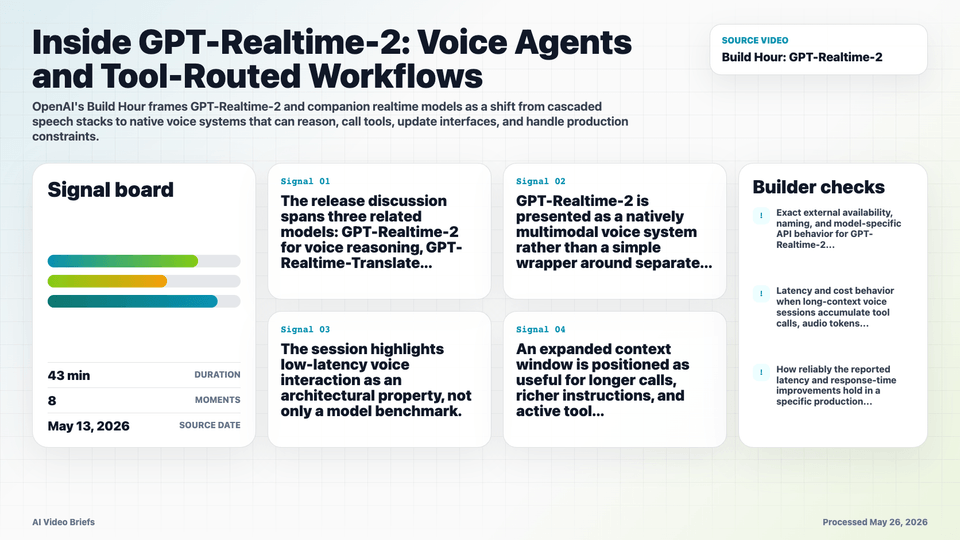
- The release discussion spans three related models: GPT-Realtime-2 for voice reasoning, GPT-Realtime-Translate for live translation, and GPT-Realtime-Whisper for streaming transcription.
- GPT-Realtime-2 is presented as a natively multimodal voice system rather than a simple wrapper around separate transcription, reasoning, and synthesis services.
- The session highlights low-latency voice interaction as an architectural property, not only a model benchmark.
- An expanded context window is positioned as useful for longer calls, richer instructions, and active tool schemas.
- Parallel tool calling lets a voice agent update multiple systems without forcing every action into a sequential spoken turn.
- Silent execution matters: some voice workflows should update a dashboard or filter data without narrating every intermediate step.
- Dynamic voice and tone controls matter because production voice agents need to manage expressiveness, speaker traits, and user trust.
- Voice activity detection is a product control surface. Builders may need different interruption policies for casual chat, support calls, and compliance playback.
- Production deployments need state management outside the realtime socket so sessions can be chained, resumed, and audited.
- Simulation-based evaluations are more relevant than isolated audio quality checks when the agent must reason, call tools, and recover from interruptions.
- Cross-lingual and expressive voice capabilities are valuable only if tool adherence remains stable under real user switching, noise, and corrections.
Builder Implications
- Design realtime voice products as event-driven systems with explicit audio, tool, UI, and state channels.
- Separate spoken responses from side effects, so UI updates and backend calls can proceed without creating unnecessary narration.
- Treat VAD and interruption policy as configurable workflow logic rather than a fixed model default.
- Persist session state out-of-band and build rehydration paths for long conversations, dropped connections, and handoffs.
- Test messy real-world audio, partial corrections, crosstalk, and tool failures before treating a demo as deployment-ready.
- Use supervisor or context-injection patterns carefully, because they can improve reliability while also adding latency and governance questions.
Things to Verify
- Exact external availability, naming, and model-specific API behavior for GPT-Realtime-2 and related realtime components.
- Latency and cost behavior when long-context voice sessions accumulate tool calls, audio tokens, and injected context.
- How reliably the reported latency and response-time improvements hold in a specific production audio environment.
- Where server-side turn detection fails under noise, crosstalk, accents, or short back-channel cues.
- Whether cross-lingual users maintain the same tool-calling accuracy and parameter fidelity as single-language users.