Executive Summary
OpenAI's Head of Codex, Thibaut Séguy, frames Codex as moving from a specialized developer tool into a broader autonomous agent for everyday knowledge work. The talk connects this shift to reliability gains in recent model iterations, and notes that non-coding tasks have become the majority of Codex operations.
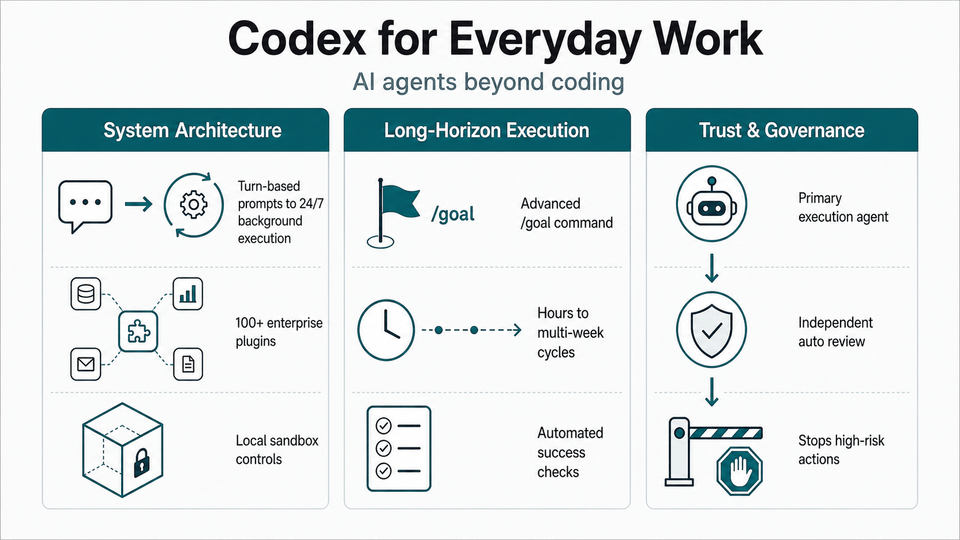
For builders, the practical message is architectural. The product frontier is not just a better prompt box; it is a system using a local application setup, workspace plugins, explicit success criteria, and verification loops that let agents work asynchronously over hours, days, or weeks without losing control of security boundaries.
A key nuance is that Codex still uses code execution under the hood to produce artifacts such as spreadsheets, maps, and slide decks, so non-coders can benefit without writing code themselves.
Key Takeaways
- Codex is presented as expanding beyond cloud pull-request automation into general-purpose agent utility for everyday work.
- The talk argues that software engineers spend only a minority of their time writing code; triage, coordination, outages, and information gathering are major automation targets.
- Codex uses code as an underlying tool for non-coding outputs, turning natural-language goals into generated files, analyses, and lightweight software.
- The advanced
/goalpattern points toward long-horizon autonomy, where an agent can pursue complex objectives across hours, days, or weeks. - The talk points toward a wave of personalized software, where people can describe a local tool and have an agent assemble it quickly.
- Enterprise context is central. Codex needs access to work systems such as documents, chats, tickets, dashboards, databases, and repositories to act usefully.
- Trust is the deployment bottleneck: data security, authorization boundaries, and prevention of destructive actions shape whether companies can adopt agents.
- OpenAI's auto-review pattern uses an independent auditing agent to watch the execution agent and halt high-risk or anomalous behavior.
- The talk warns against hyper-delegation. Teams still need conceptual engagement with the problem instead of outsourcing all judgment to an agent.
Builder Implications
- Design agent products around goals, structural success criteria, and reviewable artifacts instead of open-ended chat responses.
- Invest early in sandboxed local integration: granular directory restrictions, read-only permissions, network toggles, and explicit approval points.
- Treat context aggregation as product infrastructure. Deep plugins and fresh enterprise context matter more than isolated prompt engineering.
- Use multi-agent moderation for high-risk workflows: an execution agent should be watched by a separate validator before changes affect important systems.
- Give non-engineering teams safe agent paths for database lookup, dashboard analysis, and lightweight UI or workflow changes without bypassing governance.
Things to Verify
- Whether the long-horizon
/goalcapability is broadly available or still limited to advanced, CLI-originated, or staged surfaces. - The measured reliability of the auto-review layer, including false positives, missed risks, and failure modes under ambiguous instructions.
- The real compute, token, and operational cost profile of agents that run continuously for hours, days, or weeks.
- How 100+ integrations and plugins handle synchronization latency, authorization boundaries, stale context, and large data volumes.
- Whether teams can preserve human understanding while delegating larger portions of coordination and execution work.