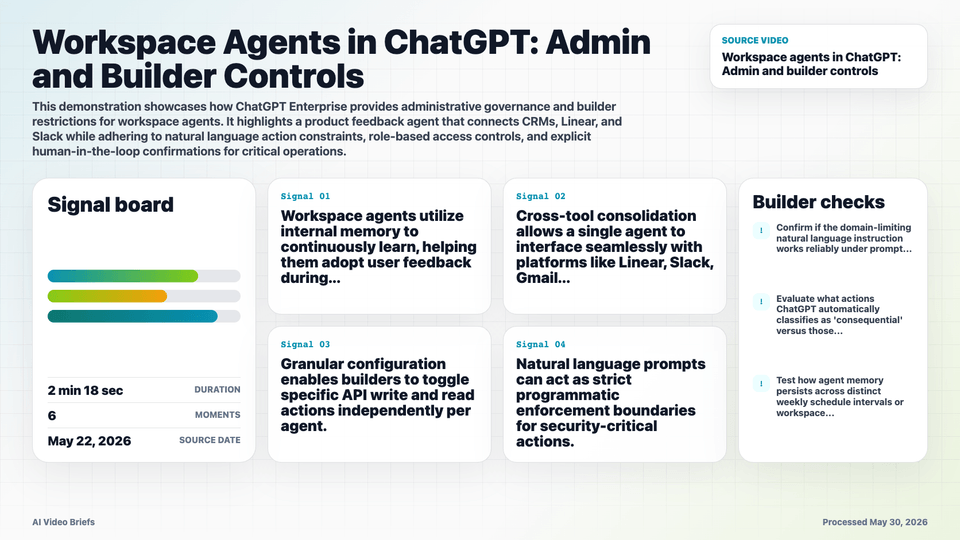
Executive Summary
Workspace agents autonomously run enterprise operations 24/7, pulling context across CRMs, documentation, and issues to output directly to tools like Slack.
Agent builders can restrict read/write access and use natural language to specify boundaries, such as confining outgoing emails to a single corporate domain.
Enterprise admins retain high-level governance via RBAC, determining who can build, publish, and connect external applications.
Human-in-the-loop confirmation flows guarantee that agents pause and request manual verification before executing highly consequential actions.
Key Takeaways
- Workspace agents utilize internal memory to continuously learn, helping them adopt user feedback during subsequent automated executions.
- Cross-tool consolidation allows a single agent to interface seamlessly with platforms like Linear, Slack, Gmail, and CRM systems.
- Granular configuration enables builders to toggle specific API write and read actions independently per agent.
- Natural language prompts can act as strict programmatic enforcement boundaries for security-critical actions.
- Admin consoles allow role-based app blacklisting or whitelisting to control enterprise security posture.
- Advanced parameters allow enterprise IT admins to impose rigorous constraint overlays on individual application integrations.
- Consequential system activities trigger automatic UI prompts requiring user sign-off before the agent proceeds.
Builder Implications
- Design agents knowing that long-running multi-tool logic can safely loop back into a team's shared channels on fixed schedules.
- Leverage natural language fields inside the builder workspace to safely lock down agent behaviors without writing custom security code.
- Verify target domains using strict recipient filtering if an agent is handling sensitive corporate artifacts or PRDs.
- Collaborate with enterprise IT admins to ensure required custom apps are pre-approved under appropriate RBAC tiers.
- Configure manual approval triggers strategically for irreversible actions to balance automation velocity with risk management.
Things to Verify
- Confirm if the domain-limiting natural language instruction works reliably under prompt injection attempts.
- Evaluate what actions ChatGPT automatically classifies as 'consequential' versus those requiring manual admin definitions.
- Test how agent memory persists across distinct weekly schedule intervals or workspace environment restarts.
- Verify the latency added to automated agent workflows when a human-in-the-loop validation barrier is triggered.