Executive Summary
Hearth AI is presented as an early agentic CRM built around the problem of augmenting human relationships rather than replacing them. Magalhaes describes how early LLM products forced builders to manage nondeterministic behavior, fragile JSON outputs, and fast-changing model capabilities while still inventing new user workflows.
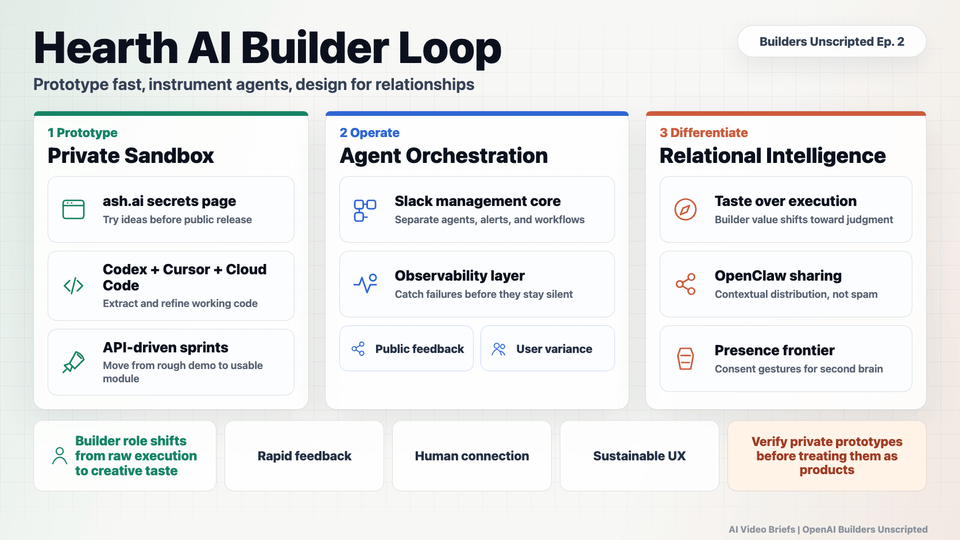
The builder workflow centers on fast private prototyping. Ashe uses ash.ai as a sandbox, keeps experimental pages behind private access, and switches across tools such as Codex, Cursor, and Cloud Code to move ideas toward standalone code. Slack channels become operational lanes for agents, alerts, and workflow separation, backed by observability for user behavior and silent failures.
The broader argument is that AI changes the builder role from manual execution to creative orchestration. When code generation becomes cheap, durable product value depends more on taste, distribution context, relational intelligence, and etiquette around ambient wearables, including consent gestures before dialogue is committed to a second brain. These systems should support human presence instead of pulling people back to screens.
Key Takeaways
- Hearth AI is framed as an early agentic CRM focused on helping people manage relationships with more context.
- The solar-car backstory frames Ashe's builder style as fast-moving but operationally rigorous.
- Paul Kalanithi's class and writing are presented as a key influence behind the relationship-centered product thesis.
- Early agentic products had to work around model instability, schema fragility, and fast-changing platform capabilities.
- Magalhaes treats ash.ai as a personal prototyping surface where private experiments can become reusable products.
- Tools such as Codex, Cursor, and Cloud Code are valuable when they turn rough product intent into code that can be extracted and refined.
- Slack channels can act as practical coordination lanes for distinct agents, alerts, and operational workflows.
- Agent products need custom observability, including user-path verification and error visibility beyond ordinary server uptime.
- Building in public creates useful user variance, but private staging still matters before broader release.
- OpenClaw is discussed as contextual distribution, where generated posts need platform-specific framing rather than generic automation.
- The video argues that engineering value shifts toward taste, judgment, and product direction as code execution becomes easier.
- Future ambient hardware concepts need social etiquette and consent patterns, such as body-touch gestures before logging a conversation.
Builder Implications
- Keep a private sandbox for fast experiments, then extract only the workflows that survive real use.
- Design agent systems with explicit operational lanes, such as separate channels for alerts, actions, and human review.
- Add product-level observability for model failures, unexpected user paths, and agent-specific errors.
- Treat taste, distribution context, and relationship quality as product requirements, not soft afterthoughts.
- For ambient AI, design consent, interruption, and social etiquette before optimizing capture or recall features.
Things to Verify
- How reliably current code agents can extract multi-file prototypes into maintainable standalone code.
- Which model and tool names from the interview are public product names versus internal shorthand.
- API limits, context overhead, and failure modes for long-running Slack-based agent orchestration.
- Whether OpenClaw-style distribution remains useful without violating platform norms or anti-spam rules.
- Privacy and security boundaries for personal relationship data inside an agentic CRM.
- Consent, data retention, and social acceptability requirements for ambient wearable concepts, including gesture-based logging controls.