Executive Summary
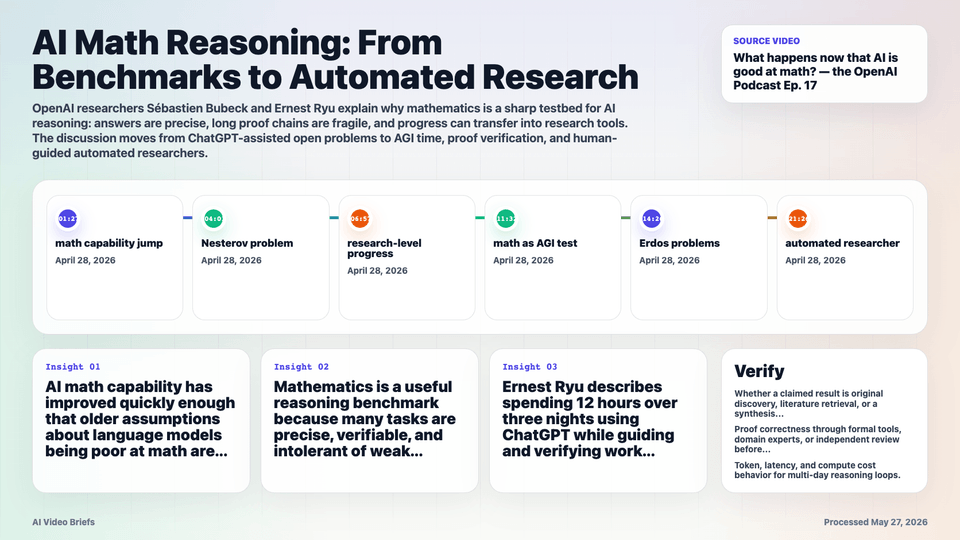
The episode frames math as one of the clearest ways to see the recent jump in AI reasoning. The speakers describe a rapid move from models that struggled with ordinary multi-step arithmetic to systems that can help expert mathematicians explore open problems, translate concepts between distant fields, and test proof ideas.
Math matters because it is unusually unforgiving. Many problems have precise answers, proofs require long chains of dependent steps, and a single bad inference can invalidate pages of work. That makes mathematics both a benchmark for reasoning models and a training ground for tools that need to extend AGI time from minutes or days toward longer horizons.
The long-term product idea is the automated researcher: an agentic workflow that searches literature, proposes approaches, checks proofs, compacts working memory, and keeps human experts in the loop. The discussion is careful about boundaries: deep retrieval is not the same as original discovery, and human taste, verification, and learning remain central.
Key Takeaways
- AI math capability has improved quickly enough that older assumptions about language models being poor at math are no longer reliable.
- Mathematics is a useful reasoning benchmark because many tasks are precise, verifiable, and intolerant of weak intermediate steps.
- Ernest Ryu describes spending 12 hours over three nights using ChatGPT while guiding and verifying work on a 42-year-old Nesterov-related open problem.
- Competition-style milestones such as IMO performance matter, but research work requires longer context, taste, and follow-through.
- The Erdos discussion separates deep literature search from original mathematical discovery; builders should not collapse those categories.
- AGI time is used as a way to talk about how long an AI system can sustain useful, coherent work before drifting.
- Automated research needs workflow scaffolding around models: search, memory compaction, proof checking, evaluation, and human review.
- The discussion says models are becoming useful at generating high-quality new research questions, not only answering existing ones.
- Context limits are a practical constraint, so long-running agents need summarization and state management rather than one giant active prompt.
- Reasoning models may be valuable for finding subtle errors in proofs, papers, code, and other long technical arguments.
- The speakers warn that expertise becomes more valuable, not less, because non-experts can generate plausible but flawed multi-page arguments.
Builder Implications
- Design toward long-horizon loops, while treating multi-week autonomous research as an active frontier rather than a solved pattern.
- Add explicit memory compaction, work logs, and source trails for any agent expected to operate across days.
- Separate retrieval, synthesis, conjecture generation, proof checking, and human approval in the interface.
- Use math-style verification patterns for other domains with long dependency chains, including code review and scientific analysis.
- Keep expert steering visible: the best product role for humans is problem selection, direction setting, and final judgment.
Things to Verify
- Whether a claimed result is original discovery, literature retrieval, or a synthesis of existing work.
- Proof correctness through formal tools, domain experts, or independent review before publishing or acting on results.
- Token, latency, and compute cost behavior for multi-day reasoning loops.
- Failure modes when summarization compresses long research histories into shorter working memory.
- Data rights, citation quality, and privacy constraints for literature and internal research corpora.
- Whether teams retain enough subject expertise to evaluate agent outputs instead of deferring to plausible explanations.