Executive Summary
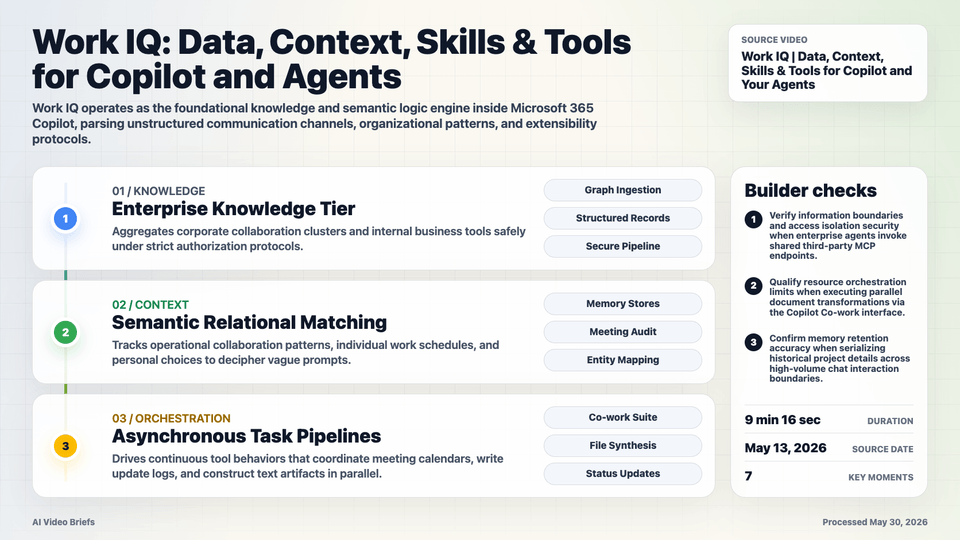
Work IQ is the structural knowledge and memory engine that sits beneath Microsoft 365 Copilot and external agents. It removes the necessity for long user prompt engineering or unsafe manual document transfers by silently aggregating unstructured user clusters (SharePoint, OneDrive, Teams, Outlook) and relational enterprise databases into a single query surface.
The framework filters interactions through a semantic relational layer that retains personal memory properties, corporate workflow priorities, and team collaboration topologies. This lets Copilot contextualize ambiguous keywords, resolve complex calendar resource conflicts by auditing surrounding meetings, and dynamically embed information protection tags during text compilation.
Infrastructure outreach is maintained through the Microsoft 365 Admin Center gallery, where developers can provision classic API-driven connectors or standard Model Context Protocol (MCP) links. API connectors ingest data directly into central search indices, whereas MCP pipelines bypass corporate indices completely to provide native read-and-write pathways into third-party operational suites.
Key Takeaways
- Work IQ combines cross-silo data streams into a unified relational graph context without file migration.
- Semantic matching algorithms map user habits and role hierarchies to automate daily scheduling optimization.
- Security validation enforcement respects local permissions, executing queries within existing corporate access scopes.
- Copilot Co-work orchestrates sequential automation chains, generating matching text, slides, and math sheets simultaneously.
- API connectors run structured data ingestion sweeps that index target records for subsequent semantic read sweeps.
- MCP server bridges expose zero-indexing operational interfaces that allow background agents to handle bidirectional data mutations.
Builder Implications
- Integrate semantic relationship schemas directly inside AI context pipelines to cleanly resolve ambiguous entity references.
- Implement automatic document tagging logic that tracks source-level classifications during compilation routines.
- Leverage parallel worker pools when designing business orchestrators to trigger asynchronous batch file creation routines.
- Incorporate dual-path integration gateways that balance static indexed read sweeps against low-footprint write-back MCP servers.
- Expose semantic database routes via centralized developer APIs to allow external shell runtimes to build compliant internal software.
Things to Verify
- Verify information boundaries and access isolation security when enterprise agents invoke shared third-party MCP endpoints.
- Qualify resource orchestration limits when executing parallel document transformations via the Copilot Co-work interface.
- Confirm memory retention accuracy when serializing historical project details across high-volume chat interaction boundaries.