Executive Summary
The demonstration highlights VS Code Insiders' new native agent ecosystem designed for hyper-focused, feature-driven developer workflows.
OpenSpec is introduced as a lightweight alternative to GitHub Spec Kit, enabling automated plan generation, design review, and task partitioning.
The sample stack utilizes a local dev container hosting SQL Server 2025, Prisma ORM for safe type-testing, and Ollama for managing local embeddings.
The workflow shows how developers can adjust SQL query logic with plain English agent requests when the app surfaces incorrect date boundaries in the UI.
Key Takeaways
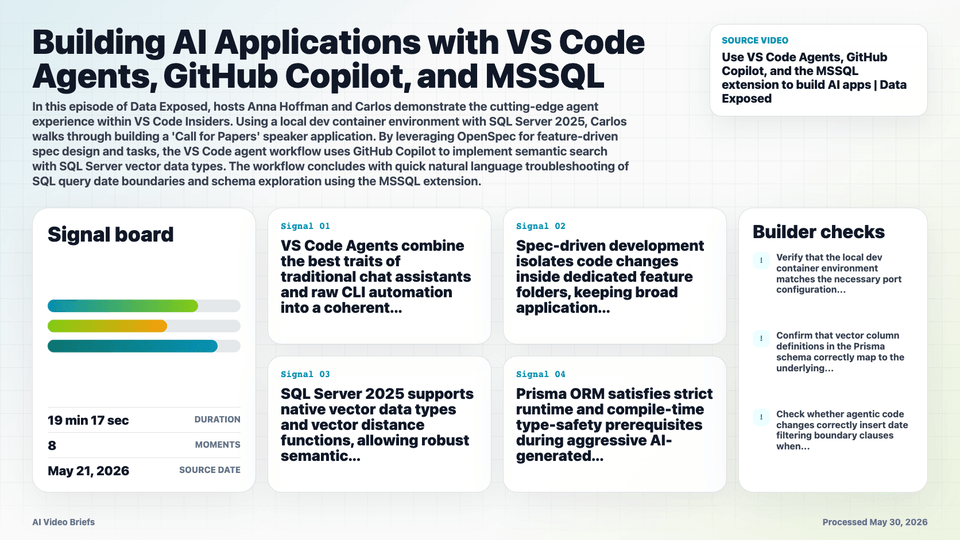
- VS Code Agents combine the best traits of traditional chat assistants and raw CLI automation into a coherent hybrid sidebar interface.
- Spec-driven development isolates code changes inside dedicated feature folders, keeping broad application environments clean and structured.
- SQL Server 2025 supports native vector data types and vector distance functions, allowing robust semantic searches entirely inside relational tables.
- Prisma ORM satisfies strict runtime and compile-time type-safety prerequisites during aggressive AI-generated agent testing loops.
- Ollama facilitates running embedding models entirely locally within a project's dev container setup, avoiding network latency or external dependencies.
- Carlos chooses bypass approvals during the feature proposal stage because the agent is only creating planning files he considers safe at that moment.
- The MSSQL extension features a built-in read-only Schema Designer tool providing swift visual graph validation of vector schemas and table boundaries.
Builder Implications
- Adopt feature-driven folder structures (e.g., '.openspec/feature-name') to help agents understand project boundaries and scope edits accurately.
- Integrate SQL Server 2025 vector distance equations inside your Next.js API routes via Prisma for clean object-relational semantic queries.
- Utilize dev containers to perfectly package complex developer dependencies like Ollama models, Next.js UI nodes, and local SQL databases.
- Iterate on database logic mismatches using plain text corrective prompts directly in the agent session to rewrite advanced SQL statements dynamically.
- Use the MSSQL extension's column filtering and data viewer to verify vector columns, embedding rows, and schema shape after generation.
Things to Verify
- Verify that the local dev container environment matches the necessary port configuration for the Next.js built-in browser engine inside VS Code.
- Confirm that vector column definitions in the Prisma schema correctly map to the underlying native vector types of SQL Server 2025.
- Check whether agentic code changes correctly insert date filtering boundary clauses when applying semantic search queries to relational tables.
- Ensure that the Ollama embedding model service is fully responsive and initialized within the environment container before running proposals.