Executive Summary
Microsoft Security teams demonstrate how Microsoft Purview extends data security posture management to autonomous agents, enforcing real-time content labeling and identifying compliance violations.
Microsoft Purview maps deep administrative visibility and data safety compliance rules directly onto autonomous AI workflows.
Semantic search lookups by background reasoning agents are subjected to strict, real-time file label validation checks.
All agent-driven interactions, prompts, and tool results are continuously ingested into immutable regulatory audit logs.
Key Takeaways
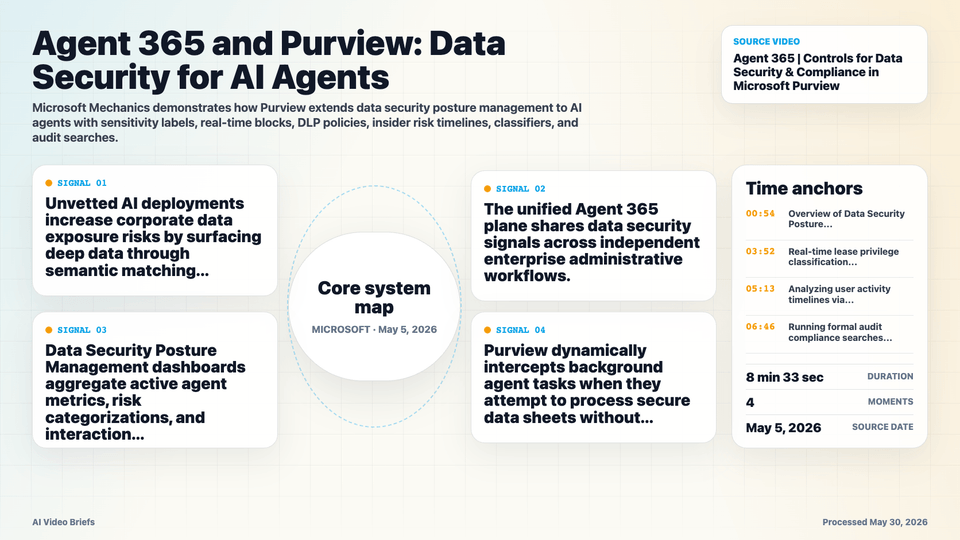
- Unvetted AI deployments increase corporate data exposure risks by surfacing deep data through semantic matching loops.
- The unified Agent 365 plane shares data security signals across independent enterprise administrative workflows.
- Data Security Posture Management dashboards aggregate active agent metrics, risk categorizations, and interaction trends.
- Purview dynamically intercepts background agent tasks when they attempt to process secure data sheets without clearances.
- Data loss prevention filters monitor automated communications, blocking outgoing summaries containing protected numbers.
- Built-in text classifiers automatically flag compliance line crossings like unethical gift incentives or unauthorized promises.
- Audit logs track exportable session identifiers including network IP strings, individual user profiles, and precise system records.
Builder Implications
- Apply uniform security classification labels to all corporate unstructured files to prepare data pools for secure agent querying.
- Incorporate real-time data loss prevention policies to block agents from transmitting data blocks to external surfaces.
- Monitor internal compliance metrics using established classification filters rather than constructing separate checking tools.
- Configure automated alerting rules to flag background agent processes that show sudden spikes in high-risk behavior traits.
- Build administrative dashboard flows that connect risk timelines directly into deep system auditing tool views.
Things to Verify
- Verify the synchronization speeds of updated file privacy labels when agents crawl active document library networks.
- Check the text classifier accuracy metrics when identifying subtle ethical compliance breaches across varied language styles.
- Measure the data indexing latency when logging high-volume agent transactions inside enterprise storage architectures.
- Assess how strict sensitivity labels affect the contextual reasoning capabilities of internal research agents.