Executive Summary
AI chatbots deployed for business workflows run the risk of providing incorrect financial, legal, or medical advice, exposing companies to massive regulatory and brand liability.
The Agent Development Kit (ADK) introduces custom callbacks acting as safety rails to intercept queries before or after agent, model, or tool invocations.
By deploying lightweight judge prompts or string checks in the middleware, unauthorized user intents are caught instantly without exposing the core LLM to the request.
Implementing stateful logic and caching via these hooks improves end-user latency and keeps developers from paying for identical tokens twice.
Key Takeaways
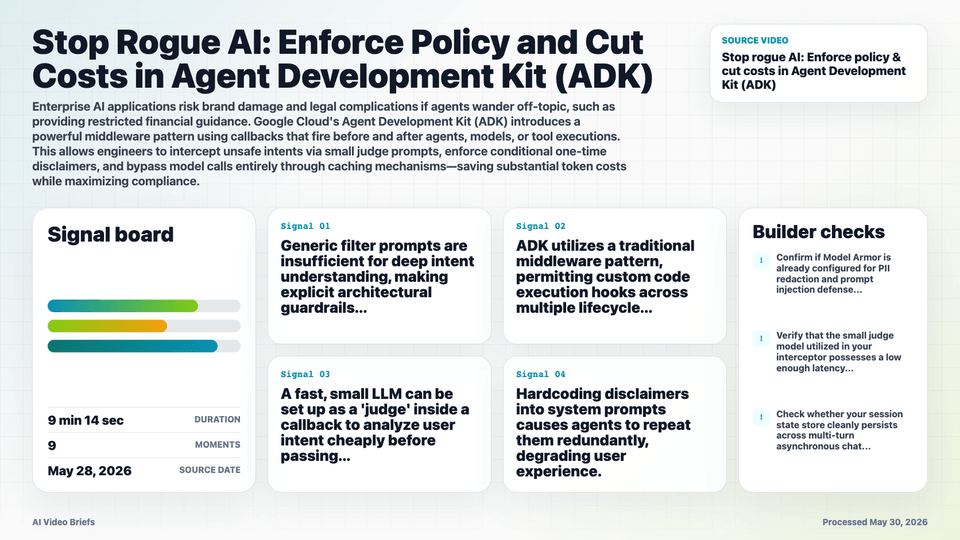
- Generic filter prompts are insufficient for deep intent understanding, making explicit architectural guardrails critical for production systems.
- ADK utilizes a traditional middleware pattern, permitting custom code execution hooks across multiple lifecycle phases.
- A fast, small LLM can be set up as a 'judge' inside a callback to analyze user intent cheaply before passing requests upstream.
- Hardcoding disclaimers into system prompts causes agents to repeat them redundantly, degrading user experience.
- A callback check can leverage application state flags to ensure a disclaimer is delivered exactly once per session.
- String-matching callbacks provide a lightweight, deterministic mechanism to immediately block prohibited topics like cryptocurrencies.
- Caching repetitive queries directly inside ADK hooks ensures fast responses and eliminates redundant model execution costs.
Builder Implications
- Inject beforeAgent functions into your pro advisor configurations to evaluate user objectives prior to routing to primary chains.
- Configure your intent judge callback to immediately return a 'blocked' status string to truncate downstream agent operations entirely.
- Utilize the callback's state object to check and update context variables such as disclaimer_shown to achieve persistent session behavior.
- Combine simple exact-string arrays with model checks to construct multi-layered validation logic for high-risk product phrases.
- Integrate an application-level cache lookup within an ADK callback to serve pre-calculated outputs instantly for high-volume corporate questions.
Things to Verify
- Confirm if Model Armor is already configured for PII redaction and prompt injection defense to separate those duties from custom intent-based ADK callbacks.
- Verify that the small judge model utilized in your interceptor possesses a low enough latency budget to prevent bottlenecking user experiences.
- Check whether your session state store cleanly persists across multi-turn asynchronous chat architectures to maintain accurate flag evaluation.
- Evaluate your cache invalidation strategy within the hook code to ensure users are not receiving stale information for dynamic queries.