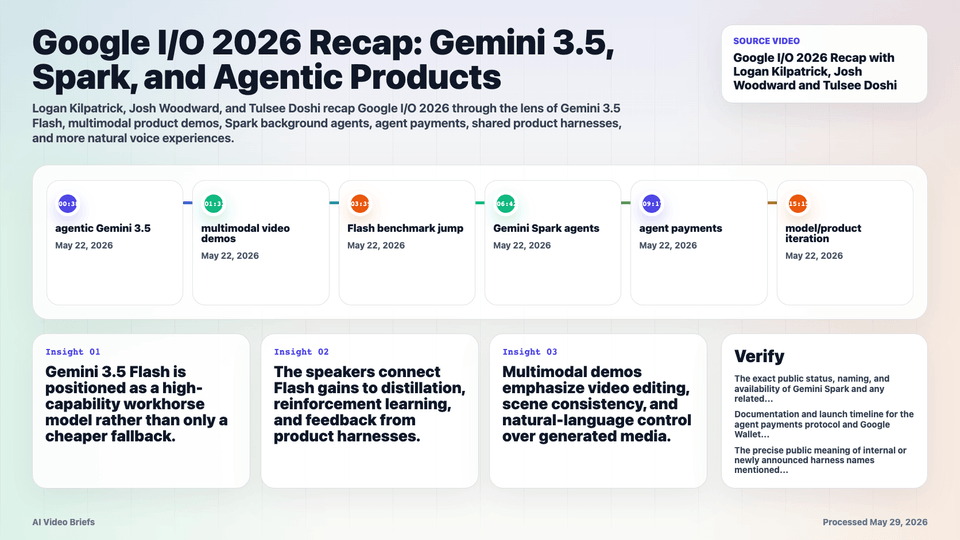
Executive Summary
The recap frames Google I/O 2026 around a shift from intelligence as a chat surface to intelligence that can act. Tulsee Doshi describes Gemini 3.5 as focused on tool use, coding, long workflows, and agentic capabilities, while the speakers connect that model progress to multimodal video demos and more expressive voice interactions.
A recurring theme is that product surfaces and model training are now tightly coupled. Gemini 3.5 Flash is described as a compact workhorse model whose gains come from distillation, reinforcement learning, and feedback from real product harnesses. Josh Woodward emphasizes that product and model teams now iterate together on system instructions, live experiments, and product behavior.
Gemini Spark is presented as a background agent experience that can turn messy user brain dumps into managed task dashboards, while agent payments point toward controlled action in commercial contexts through Google Wallet constraints. The session's builder message is clear: the next useful AI products will combine strong models with explicit harnesses, budget controls, human confirmation points, and interfaces that adapt to user expertise.
Key Takeaways
- Gemini 3.5 Flash is positioned as a high-capability workhorse model rather than only a cheaper fallback.
- The speakers connect Flash gains to distillation, reinforcement learning, and feedback from product harnesses.
- Multimodal demos emphasize video editing, scene consistency, and natural-language control over generated media.
- Gemini Spark is described as a background agent that can break messy requests into separate executable tasks.
- Google is exploring agent payments through Google Wallet with explicit merchant and spending constraints.
- The product process is moving away from model teams and product teams working in isolation.
- Voice interactions are treated as a major interface shift because naturalness, expressiveness, and dialect support are improving quickly.
Builder Implications
- Design agent products around durable task state, not only one-shot chat replies.
- Pair autonomous execution with conservative confirmation points for payment, purchase, or other high-impact actions.
- Build product harnesses that feed real behavior back into prompt, system-instruction, and model-evaluation loops.
- Let interfaces scale with user sophistication: offer simple daily digests as well as deeper schedules, triggers, and controls.
- Plan product roadmaps in shorter cycles when foundation-model capability is changing every few months.
- Treat voice as a primary interaction surface when the product benefits from immediacy, expression, or hands-free context.
Things to Verify
- The exact public status, naming, and availability of Gemini Spark and any related background-agent dashboards.
- Documentation and launch timeline for the agent payments protocol and Google Wallet merchant constraints.
- The precise public meaning of internal or newly announced harness names mentioned in the recap.
- Real-world token consumption, latency, and reliability for always-on background agents after launch.
- Which voice and multimodal editing capabilities are generally available versus demo-only or limited-access features.