Executive Summary
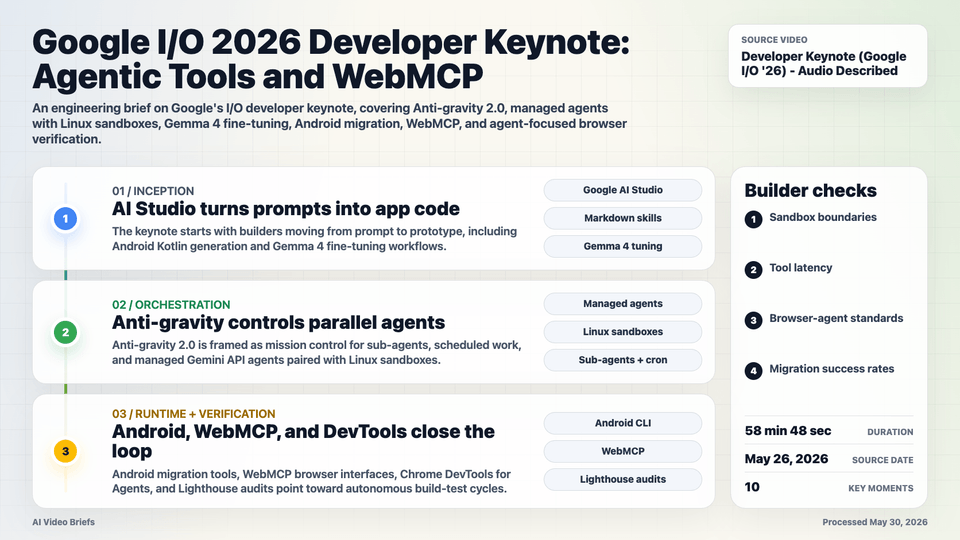
The Google I/O 2026 Developer Keynote frames the next software-development shift as a move from reactive assistants to autonomous, multi-agent workflows centered on Google Anti-gravity. Gemini's analysis highlights a connected platform story: AI Studio for prototyping, Gemini API managed agents with Linux sandboxes for sandboxed execution, and Anti-gravity 2.0 for sub-agent orchestration and scheduled work.
The talk also extends the agent story into concrete builder surfaces. Google shows Android Kotlin generation, voice-controlled Gemma 4 fine-tuning, Android CLI and knowledge-base integrations, an Android Studio migration assistant for iOS-to-Android work, and a proposed WebMCP browser standard.
For builders, the key message is that agent quality is becoming an end-to-end systems problem. Tool latency, sandbox boundaries, web-page semantics, browser verification, and migration reliability matter as much as model capability.
Key Takeaways
- Google Anti-gravity is presented as the agentic development platform that unifies cloud, local, Android, and web workflows.
- Managed agents in the Gemini API can provision Google-hosted remote Linux sandboxes for more complex orchestration tasks.
- Anti-gravity 2.0 is positioned as a mission-control layer for dynamic sub-agents and scheduled cron-style work.
- Gemma 4 fine-tuning is shown as an increasingly interactive workflow, including an on-stage voice-controlled LoRA demonstration.
- Android CLI, skills, and knowledge-base integrations are presented as ways for agents to handle legacy migration work with less overhead.
- The proposed WebMCP browser standard aims to let web apps expose actionable JavaScript capabilities directly to browser-based agents.
- Chrome DevTools for Agents and Lighthouse-style autonomous audits are presented as the verification side of agentic development.
Builder Implications
- Design agent products around explicit lifecycle layers: ideation, orchestration, sandboxed execution, runtime integration, and verification.
- Treat sandbox provisioning as a first-class product surface when agents need to run scripts, inspect files, or coordinate multiple tools.
- Prepare mobile stacks for hybrid execution paths that combine IDE assistance, CLI automation, knowledge bases, and on-device or cloud model fallback.
- Expose web capabilities through structured interfaces so browser agents can invoke product actions instead of relying only on visual guessing.
- Add agent-facing QA to frontend workflows by improving semantic structure, machine-readable routing hints, and repeatable Lighthouse-style audits.
Things to Verify
- Whether the Android CLI, skills, and knowledge-base improvements deliver the same token and speed gains in custom enterprise codebases.
- How stable the proposed WebMCP browser standard is across frameworks, browsers, and security models during its early trial phase.
- How well the Android Studio iOS-to-Android migration assistant handles complex production interfaces, custom platform APIs, and failure recovery.
- What runtime overhead and accessibility tradeoffs appear when using the experimental HTML in Canvas API.