Executive Summary
In this briefing, Google DeepMind's key technical leaders reflect on the consolidation of Google Brain and DeepMind that yielded the Gemini project. They discuss the launch of the Gemini 3.5 era, focusing on the efficiency of Flash and the architectural realization of the early Pathways vision—specifically sparse, unified, multimodal models. The leaders provide critical insights into why they value user-centric production telemetry over simulated benchmark optimization. Finally, they project the next systemic shift toward long-running autonomous agents, noting that external human-facing tool latency, not pure inference throughput, is becoming the primary operational bottleneck.
Key Takeaways
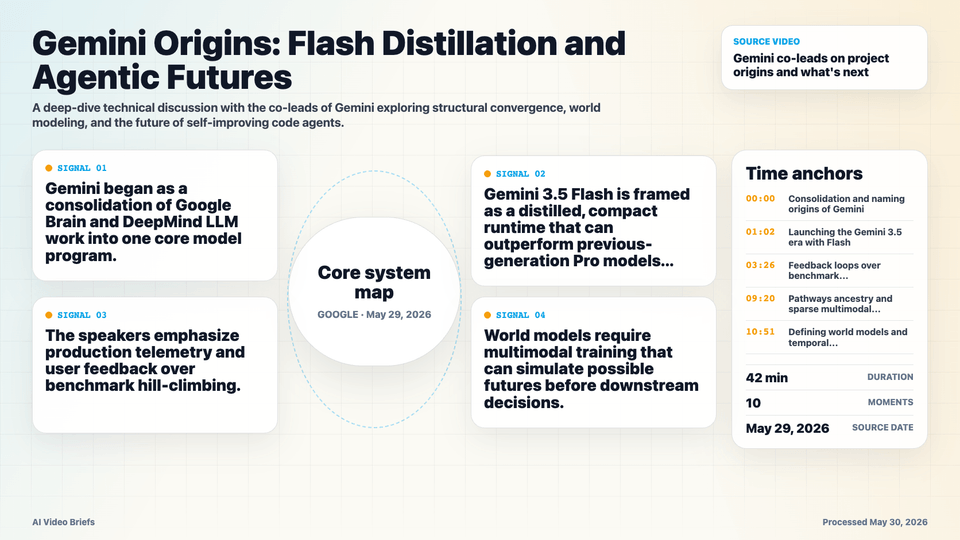
- Gemini began as a consolidation of Google Brain and DeepMind LLM work into one core model program.
- Gemini 3.5 Flash is framed as a distilled, compact runtime that can outperform previous-generation Pro models on some tracks.
- The speakers emphasize production telemetry and user feedback over benchmark hill-climbing.
- World models require multimodal training that can simulate possible futures before downstream decisions.
- Knowledge distillation has moved from massive ensembles toward simpler teacher-student training loops.
- Data efficiency remains a gap: the speakers say models still need far more experience than humans.
- Long-running agents will expose external tool and API latency as a key operational bottleneck.
Builder Implications
- Prioritize real-world integration telemetry over optimization for static academic leaderboards to avoid artificial capability regressions.
- Leverage highly compact models like Flash for production deployments, as modern knowledge distillation yields reasoning profiles that outperform older, massive legacy models.
- Design application layers to support multimodal reasoning from the ground up, recognizing that non-text modalities enrich core spatial and structured data comprehension.
- Prepare system architectures for agentic workflows by auditing and optimizing the latency of internal tools, APIs, and execution environments.
- Anticipate future infrastructure capabilities where inference hardware is co-designed around flexible or sparse model routing infrastructures.
Things to Verify
- The specific parameter scale and distillation loss configurations underpinning the Gemini 3.5 Flash efficiency gains.
- The exact computational tradeoffs and accuracy variances experienced when training a single-teacher student versus old-school massive model ensembles.
- The precise implementation definitions of 'world modeling' within Gemini Omni compared to predictive video architectures like Sora or Imagen Video.
- The claim regarding the exact factor of data-inefficiency (stated as 1,000x human data consumption) and how organic architectures might close this gap.