Executive Summary
Google DeepMind and Cloud executives discuss Gemini 3.5 Flash capabilities, multi-agent anti-gravity systems, and how solving enterprise information retrieval bottlenecks transforms the software development lifecycle.
Gemini 3.5 Flash outpaces legacy models on complex tool usage and extended multi-step trajectories while tracking execution speeds over 200 tokens per second.
The engineering challenge has transformed from basic code generation into architecting structured multi-agent systems that delegate tasks asynchronously.
Enterprise deployment boundaries are governed by data safety and information retrieval capabilities rather than basic model intelligence limits.
Key Takeaways
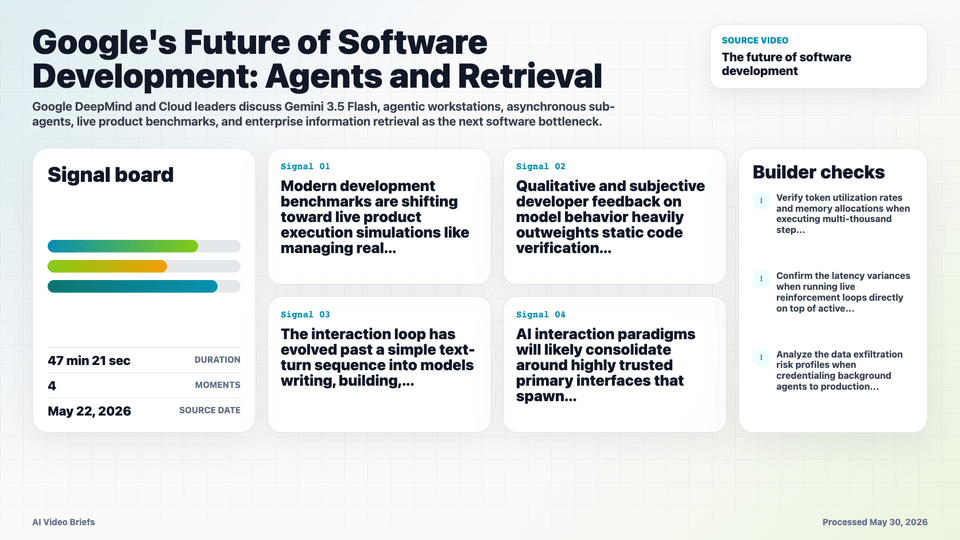
- Modern development benchmarks are shifting toward live product execution simulations like managing real e-commerce stores for profit.
- Qualitative and subjective developer feedback on model behavior heavily outweights static code verification scores during integration.
- The interaction loop has evolved past a simple text-turn sequence into models writing, building, and recursively adjusting software tasks.
- AI interaction paradigms will likely consolidate around highly trusted primary interfaces that spawn specialized sub-agents natively.
- Enterprise validation processes require models to know when to pause, evaluate information gaps, and query humans before continuing execution.
- A core bottleneck for engineering agents is processing massive context streams with real-time framework inputs.
- The anti-gravity platform allows root agents to explicitly select distinct underlying model profiles for asynchronous sub-tasks.
Builder Implications
- Stop designing tools around single-turn chat boxes and rearchitect software interfaces for continuous background workflows.
- Incorporate robust integration and playground testing scripts directly into the root directory of all new zero-to-one software projects.
- Build specific agent interruption rules that govern how frequently a running agent can prompt or alert a human supervisor.
- Focus product strategy on user experience and problem discovery, as basic feature construction is completely commoditized.
- Leverage model delegation models where large models orchestrate and dispatch highly narrow tasks to fast flash layers.
Things to Verify
- Verify token utilization rates and memory allocations when executing multi-thousand step asynchronous model loops.
- Confirm the latency variances when running live reinforcement loops directly on top of active system developer harnesses.
- Analyze the data exfiltration risk profiles when credentialing background agents to production relational data lakes.
- Evaluate the accuracy delta of Gemini 3.5 Flash when debugging multi-decade legacy codebases versus newly structured web applications.