Executive Summary
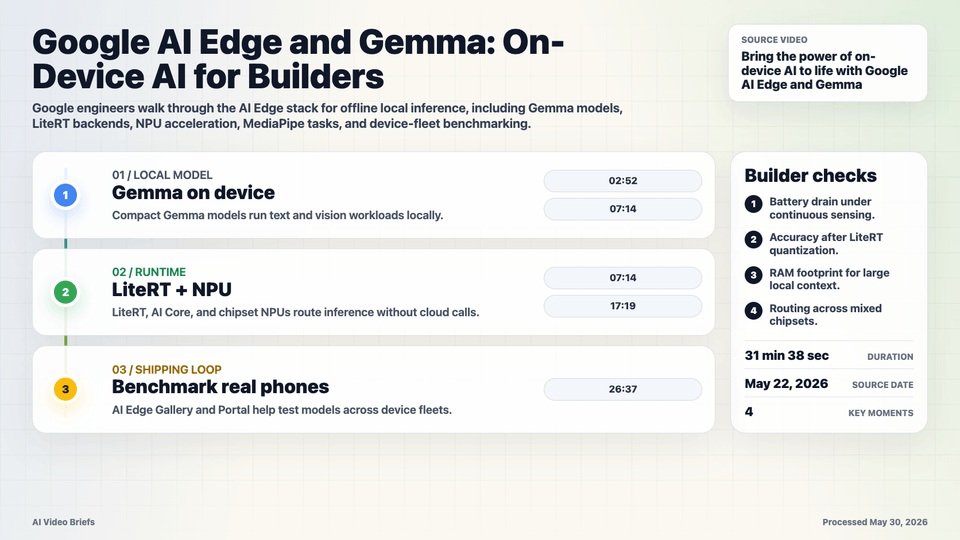
Google engineers introduce the AI Edge stack, demonstrating high-speed local inference with Gemma models, Light RT backends, and pre-built MediaPipe vision solutions running completely offline.
The Google AI Edge stack eliminates cloud API costs and connectivity dependencies by executing full text and vision models directly on device silicon.
Hardware optimization engines combine ARM architectures and dedicated NPUs to cross execution speeds of over 200 tokens per second.
The memory transfer rate between physical device memory and the processing chip has replaced raw compute capability as the primary system bottleneck.
Key Takeaways
- Latest compact Gemma models routinely outperform multi-fold larger frontier models from previous software generations.
- Light RT serves as the low-level execution engine while Light RT LM introduces streamlined text-in, text-out interfaces.
- Production-grade NPU support has expanded across chipsets including Google Tensor, Intel, Qualcomm, and MediaTek frameworks.
- The complete AI Edge Gallery application code is open-sourced on GitHub to serve as an architectural foundation for developers.
- On-device libraries offer native methods to manage memory configurations and persist multi-turn user conversation threads locally.
- MediaPipe provides plug-and-play local tasks covering high-speed pose landmarking, image categorization, and gesture matching.
- The AI Edge Portal allows developers to benchmark fine-tuned models directly across an active cloud-managed fleet of real phones.
Builder Implications
- Transition high-frequency interactive features from cloud endpoints to on-device hardware models to eliminate recurring server expenses.
- Utilize the AI Edge Torch package to compile custom PyTorch weights directly into portable, hardware-accelerated .tflight structures.
- Leverage mobile OS layers like Gemini Nano and AI Core via MLKit to access hardware acceleration natively.
- Implement deep memory mapping and custom OpenCL rules to prevent background agent loops from causing user interface stutter.
- Deploy classic machine learning architectures on edge computing hardware for continuous sensing pipelines to maximize battery lifespan.
Things to Verify
- Test the precise battery drain curves of edge devices when processing continuous audio classification loops over multiple hours.
- Verify the performance and accuracy changes that occur when quantizing large custom open models down to Light RT formats.
- Measure the exact RAM and execution footprint increases when holding large context windows active inside mobile device memory.
- Confirm chipset routing cross-compatibility when deploying custom vision assets across mixed GPU and CPU hardware ecosystems.