Executive Summary
VS Code is evolving into an AI-first editor by decoupling the chat workflow from the standard editor sidebar into a dedicated agent window. This window treats multi-agent loops, remote sessions, and workspace interactions as primary citizens, mitigating workspace constraints.
Every session is powered by an independent Agent Host Process (AHP). Because it communicates over a standard protocol, users can effortlessly initialize a task locally, spin up code tunnels or SSH connections, and seamlessly monitor or approve actions from secondary devices including mobile web interfaces.
To support diverse infrastructure requirements, the editor introduces granular tool approval modes—Default, Bypass, and Autopilot—alongside fully decoupled Bring Your Own Key (BYOK) configurations. Developers can route language model queries directly to providers like Anthropic or custom air-gapped endpoints without signing into Copilot.
Key Takeaways
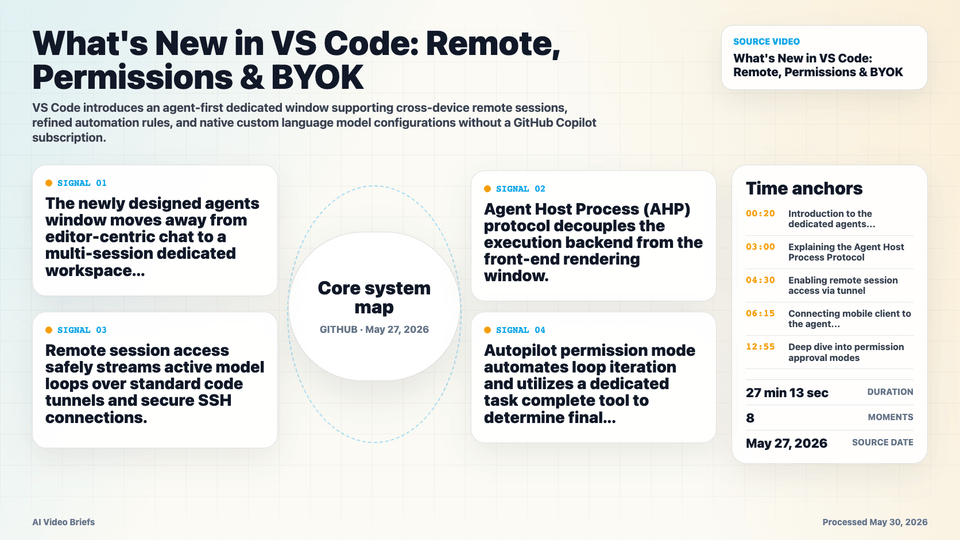
- The newly designed agents window moves away from editor-centric chat to a multi-session dedicated workspace interface.
- Agent Host Process (AHP) protocol decouples the execution backend from the front-end rendering window.
- Remote session access safely streams active model loops over standard code tunnels and secure SSH connections.
- Autopilot permission mode automates loop iteration and utilizes a dedicated task complete tool to determine final status.
- Bypass approvals mimic global auto-approve settings but strictly pause for targeted user queries or off-topic filters.
- Native BYOK allows direct configurations for Anthropic, custom chat completion endpoints, and third-party extensions like Hugging Face without active Copilot logins.
Builder Implications
- Architect AI-driven systems to split the UI container from the tool-execution environment utilizing lightweight protocol patterns.
- Incorporate robust fallback hooks when designing multi-step autonomous workflows to gracefully handle token limit failures or systemic errors.
- Adopt explicit state verification systems like the task complete tool to confirm proper objective alignment before ending a run.
- Build multi-device sync strategies allowing engineers to supervise complex processing pools via lightweight mobile environments.
- Ensure enterprise software frameworks support modular BYOK plumbing to seamlessly adapt to private models and strict privacy boundaries.
Things to Verify
- Verify stability and connection durability of code tunnels when executing intensive compilation scripts across low-bandwidth connections.
- Qualify the behavioral differences and failure risks associated with bypassing sandbox restrictions in different permission settings.
- Confirm how utility models handle fallback logic when processing backend requests like commit generation through custom JSON configurations.