Executive Summary
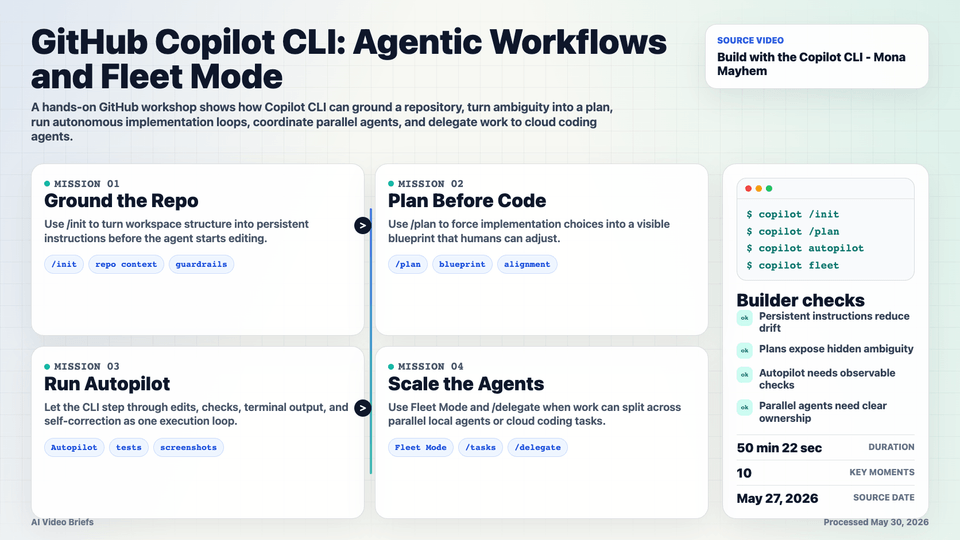
This GitHub workshop uses a retro arcade project, Mona Mayhem, to show Copilot CLI as more than a chat prompt wrapped around code completion. The workflow starts by grounding the repository with durable instructions, then uses planning and execution modes to make the agent behave like a structured coding collaborator.
The strongest product lesson is the separation between context, planning, execution, and orchestration. /init creates persistent repository guidance, /plan turns ambiguity into a reviewable implementation path, and Autopilot runs multi-step edits with checks instead of treating each prompt as an isolated turn.
The later sections move into scale: plugin marketplace tools, Fleet Mode for concurrent local agents, and /delegate for cloud-hosted coding work. For builders, the message is that agentic coding quality depends on workflow design, visible constraints, and task boundaries as much as model capability.
Key Takeaways
/initis presented as the first grounding step: it scans the workspace and writes repository instructions that keep later agent behavior aligned with local conventions./planchanges the interaction from immediate code generation to a blueprint-first flow where assumptions, data structures, and implementation steps can be reviewed before edits begin.- Autopilot is shown as a longer-running execution loop that can edit, observe results, react to failures, and continue through multiple steps rather than waiting for a new prompt each time.
- Multimodal debugging and terminal output become part of the agent feedback loop, making screenshots, errors, and validation signals important product surfaces.
- The plugin marketplace expands what the CLI agent can do, but also makes tool governance and permission boundaries more important.
- Fleet Mode is framed as a way to coordinate concurrent agents on separable tasks, with the workflow needing explicit task boundaries to reduce conflict.
/delegatepoints toward cloud-hosted coding agents that can take longer-running work out of the local terminal and return reviewable pull requests.
Builder Implications
- Treat repository instructions as product infrastructure, not prompt decoration. Durable context is what lets an agent survive across multi-step work.
- Make planning artifacts visible and reviewable before high-impact edits. Agentic coding needs explicit assumptions and a place to catch design ambiguity.
- Design execution loops around observable checks: terminal output, tests, screenshots, and diffs should all feed the agent before a human reviews the result.
- Use parallel agents only when the work can be split cleanly by ownership boundary, file area, or acceptance criteria.
- For cloud delegation, optimize for reviewability: small pull requests, clear task descriptions, and traceable validation matter more than raw autonomy.
Things to Verify
- How Fleet Mode handles conflicts when multiple agents touch tightly coupled files or shared project configuration.
- Which Copilot CLI modes and commands are broadly available versus preview, account-limited, or environment-dependent.
- How much token and cost overhead persistent instructions, planning artifacts, and long-running Autopilot loops introduce on larger repositories.
- Whether delegated cloud tasks preserve enough context and validation evidence for teams to review them safely.