Executive Summary
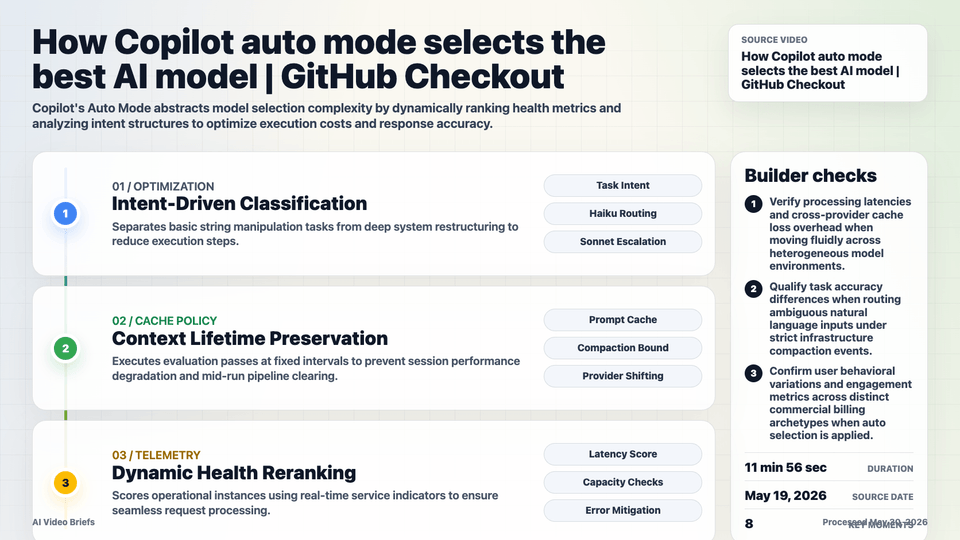
GitHub Copilot's Auto Mode isolates developers from fluctuating model versions by managing routing logic under a single configuration profile. The underlying system automatically maps user prompts to tailored processing layers based on real-time parameters.
The infrastructure coordinates dual evaluation engines: a real-time health monitor that constantly re-ranks active model endpoints across latency, regional capacity, and systemic errors, alongside an asset router that classifies the intent, debugging depth, and orchestration requirements of any incoming job.
To preserve intermediate prompt caching and avoid mid-session performance penalties when shifting between distinct AI vendors, intent categorization runs selectively at the creation of a session and immediately after contextual window compaction points. Future iteration milestones aim to expand this routing matrix into granular sub-agents, splitting tasks among dedicated triage, specification, and execution routines.
Key Takeaways
- Auto Mode removes manually selected policies by natively matching tasks to optimized provider endpoints in real time.
- Low-reasoning inputs quickly execute over lightweight instances like Claude Haiku 4.5 to minimize computation duration.
- High-reasoning jobs seamlessly escalate to premium processing configurations such as Claude Sonnet 4.6.
- Intent classifications are minimized to session startup and post-compaction bounds to stabilize prompt cache residency.
- Selection systems use live re-ranking metrics based on service capacity, response latency, and endpoint errors.
- Rigorous performance testing uses a blended ecosystem of automated Sweetbench scores and controlled online validation runs.
Builder Implications
- Construct multi-tenant LLM gateways using decoupled orchestration pipelines that evaluate infrastructure availability prior to emitting tokens.
- Throttle active intent classification frequencies across stateful conversational sessions to maximize compiler prompt caching behavior.
- Implement blended testing methodologies combining offline verification steps with small-batch online canary distributions to properly benchmark variable prompt results.
- Design platform routing matrices to exploit performance overlap intersections where smaller models match or beat premium engines.
- Prepare agent development trees to support specialized sub-agent handoffs where individual tasks utilize separate fine-tuned models.
Things to Verify
- Verify processing latencies and cross-provider cache loss overhead when moving fluidly across heterogeneous model environments.
- Qualify task accuracy differences when routing ambiguous natural language inputs under strict infrastructure compaction events.
- Confirm user behavioral variations and engagement metrics across distinct commercial billing archetypes when auto selection is applied.