Executive Summary
The session presents Claude Managed Agents as a managed runtime for building enterprise agent applications without hand-rolling every orchestration primitive. Isabella He contrasts raw Messages API calls and self-hosted agent SDK work with a server-side agent loop that handles context management, session durability, and scaling on Anthropic infrastructure.
The core architectural idea is to separate the agent's reasoning loop from tool execution. The agent loop runs server-side, while tools run in isolated or private compute environments. The video frames that separation as both a security boundary for secrets and credentials and a latency win, with a cited P95 time-to-first-token reduction above 90%.
The workshop builds an SRE incident-response agent using Claude Opus 4.7, Files API log context, custom metrics tools, sessions, and workspace events. The demo diagnoses database pool exhaustion and recommends next actions; it should not be summarized as an agent that automatically fixes production. After the workshop, advanced primitives such as subagents, memory dreaming, vaults, and webhooks are introduced as deployment building blocks.
Key Takeaways
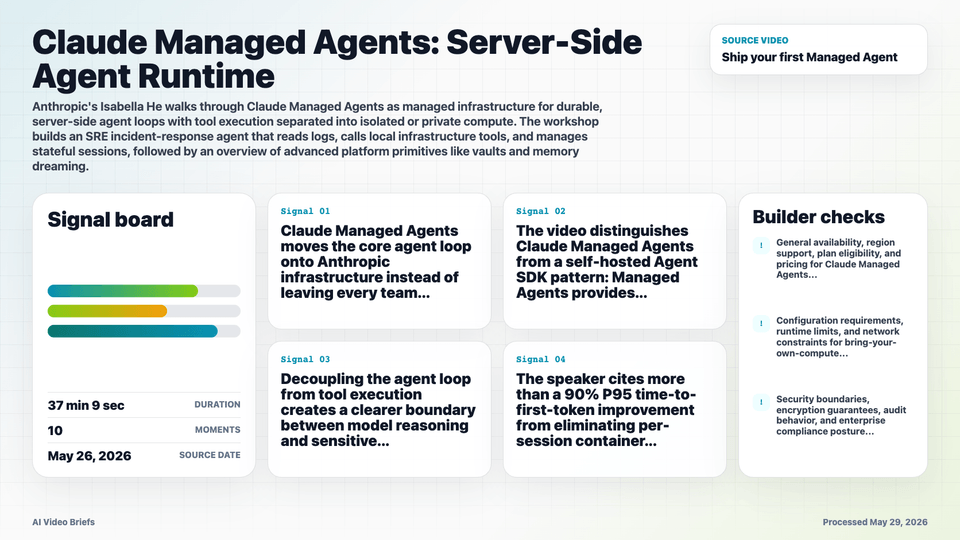
- Claude Managed Agents moves the core agent loop onto Anthropic infrastructure instead of leaving every team to build context compaction, caching, retries, and session management.
- The video distinguishes Claude Managed Agents from a self-hosted Agent SDK pattern: Managed Agents provides a server-side runtime rather than only a framework.
- Decoupling the agent loop from tool execution creates a clearer boundary between model reasoning and sensitive runtime credentials.
- The speaker cites more than a 90% P95 time-to-first-token improvement from eliminating per-session container spin-up overhead.
- Bring-your-own-compute support lets teams run tool environments inside private infrastructure, but the operational limits need verification.
- The speaker's internal harness example shows why managed orchestration must evolve with model behavior rather than hard-code one model generation's quirks.
- The workshop uses a structured event log for user messages, tool outputs, and workspace state instead of treating the agent as a stateless request-response endpoint.
- The SRE demo ingests system logs through the Files API and calls custom infrastructure tools to diagnose database pool exhaustion.
- Session states such as idle, running, rescheduling, and terminated make lifecycle behavior explicit for long-running agents.
- The closing section introduces advanced primitives including subagent orchestration, memory dreaming, encrypted vaults for credentials, webhook triggers, and evaluation rubrics.
Builder Implications
- Move repeated orchestration concerns into managed agent configuration when the platform can own durability, scaling, and session state.
- Design a hard boundary between the server-side reasoning loop and the private compute surface that executes tools.
- Model product telemetry as workspace events so teams can debug agent state, tool outputs, and user actions over time.
- Feed files, logs, traces, and runtime artifacts into the workspace when the agent needs grounded operational context.
- Use automated rubrics and memory workflows carefully; treat self-improvement as an auditable product loop, not magic autonomy.
Things to Verify
- General availability, region support, plan eligibility, and pricing for Claude Managed Agents and Claude Opus 4.7.
- Configuration requirements, runtime limits, and network constraints for bring-your-own-compute containers.
- Security boundaries, encryption guarantees, audit behavior, and enterprise compliance posture for Vault credentials.
- How MCP tunnels, firewall rules, and private infrastructure connectivity are configured and monitored.
- Data retention and deletion semantics for sessions, workspace events, files, logs, and derived memory.
- Latency, cost, evaluation overhead, and failure modes for memory dreaming and other advanced primitives.