Executive Summary
Anthropic co-creator David details the open-source Model Context Protocol (MCP) designed to standardize tool integrations across model providers and its official donation to the Linux Foundation.
The Model Context Protocol establishes an open interoperability layer that eliminates the need to build custom integrations for every individual model provider.
Donating the protocol to the Linux Foundation and the Agentic AI Foundation secures trademarks and open licensing against future vendor lock-in.
MCP shifts agent interactions beyond plain text formatting by enabling deep, stateful developer tools, remote scaling structures, and programmatic UIs.
Key Takeaways
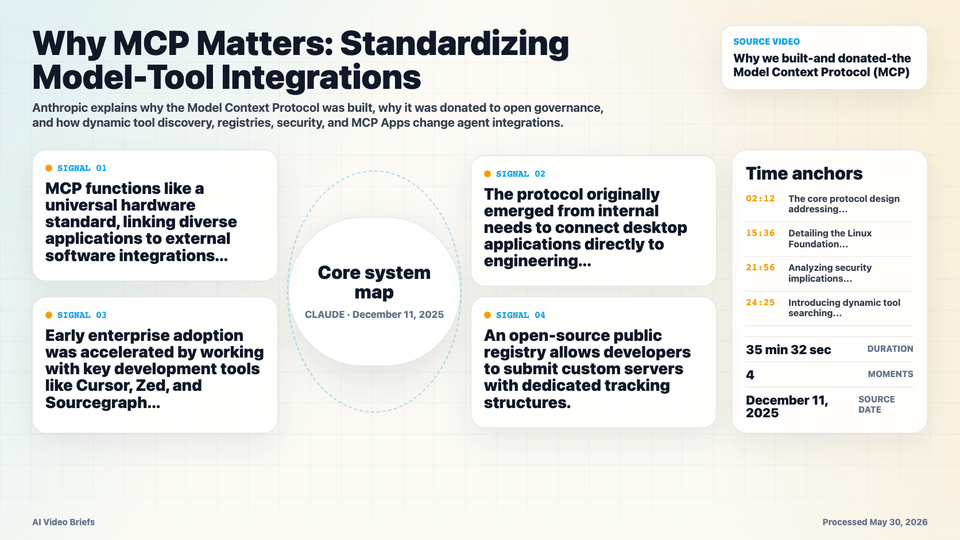
- MCP functions like a universal hardware standard, linking diverse applications to external software integrations seamlessly.
- The protocol originally emerged from internal needs to connect desktop applications directly to engineering environments and whiteboards.
- Early enterprise adoption was accelerated by working with key development tools like Cursor, Zed, and Sourcegraph from the launch.
- An open-source public registry allows developers to submit custom servers with dedicated tracking structures.
- The protocol natively exposes applications to critical threat entry points like prompt injection and malicious data exfiltration.
- Context bloat is mitigated on the application layer by replacing full tool preloading with targeted semantic tool searches.
- The introduction of 'tasks' into the core protocol specification enables asynchronous, long-running agent-to-agent communication links.
Builder Implications
- Write application tool integrations once using the open MCP standard instead of maintaining custom API connectors for each model.
- Implement client-side programmatic tool calling to execute intermediate data transformations completely inside isolated code blocks.
- Utilize dynamic tool searching methods to limit active context sizes to immediate operational needs rather than dumping full lists.
- Establish custom enterprise sub-registries to perform strict security vetting and supply-chain validations before ingestion.
- Build future frontend surfaces to leverage the new MCP Apps standard, enabling rich structural layout cards instead of flat text text responses.
Things to Verify
- Analyze the runtime memory overhead and scaling limitations caused by the protocol's stateful session requirements.
- Verify the effectiveness of read-only protocol flags when preventing malicious prompt injection write attempts.
- Test the data exfiltration vulnerabilities present when connecting third-party open-source registry servers to live databases.
- Assess the performance latency differences between native command-line execution tools and localized remote HTTP MCP servers.