Executive Summary
The scaling power of highly capable modern LLMs allows agents to run for longer periods, demanding an intentional shift from naive human instructions toward structured engineering environments.
Vague imperative prompt habits cause token inefficiencies; developers should let Claude Code ask structured user questions, with the concrete interview workflow appearing after the initial Bitter Lesson framing.
Markdown is hit by a scale constraint when documents cross roughly 200 lines, making structured HTML files the superior, information-dense 'lingua franca' for multi-variant UI and spec reviews.
Anthropic infrastructure separates app verification from standard test suites by embedding the underlying data state explicitly into the DOM, making UI testing agent-readable and decoupled from strict React internals.
Key Takeaways
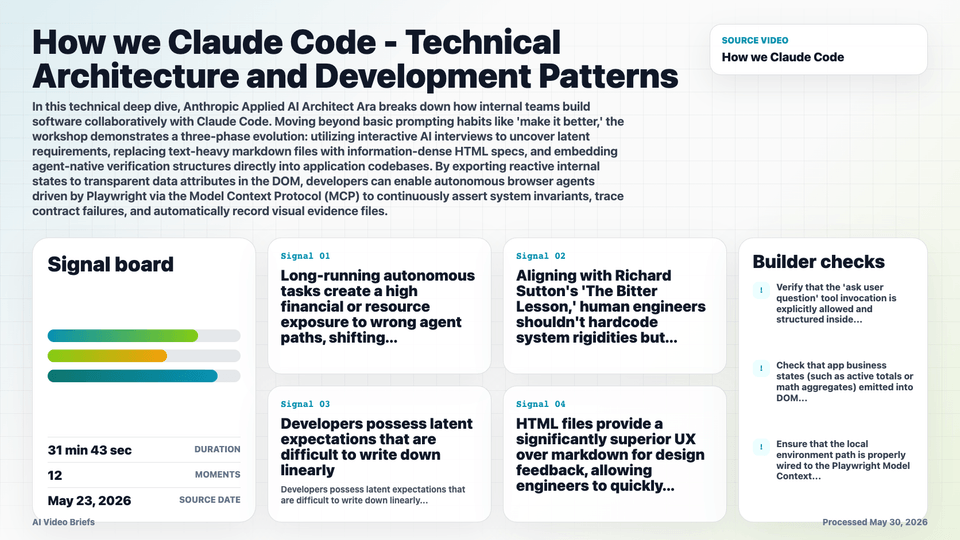
- Long-running autonomous tasks create a high financial or resource exposure to wrong agent paths, shifting the developer's primary job to frontloading specifications.
- Aligning with Richard Sutton's 'The Bitter Lesson,' human engineers shouldn't hardcode system rigidities but rather build platforms that leverage raw model capabilities and compute scaling.
- Developers possess latent expectations that are difficult to write down linearly; allowing Claude Code to interview the user discovers missing boundary constraints.
- HTML files provide a significantly superior UX over markdown for design feedback, allowing engineers to quickly swap aesthetics, view multi-axis layouts, and easily feed rendered canvas screenshots back into multi-modal models.
- The Claude Code internal testing paradigm relies on injecting test schemas, fixtures, and immutable system invariants into the live DOM layout.
- Standard DOM scraping is brittle for AI agents; exposing dedicated validation attributes (e.g., total, done, active counts) provides a robust data contract for autonomous scripts.
- Integrating the Playwright Model Context Protocol (MCP) tool allows Claude Code to open browser clients headlessly, interact with elements, and visually diagnose failing UI components in real time.
- Anthropic engineering workflows dynamically export recorded verification video clips to cloud buckets like S3, providing transparent proof of working pull requests with zero human overhead.
Builder Implications
- Use the Claude Code interactive terminal controls deliberately, including the Shift+Tab cycling behavior shown in the workshop, rather than treating it as a universal automation toggle.
- When running computationally heavy, multi-turn coding loops, scale the CLI effort parameter up to 'X high' or 'max effort' to fully exploit reasoning models like Opus 4.7.
- When evaluating complex multi-component frontends, capture full-page UI screenshots and feed them directly back into the terminal agent to exploit modern high-fidelity visual reasoning.
- Adopt a contract-driven HTML UI spec pattern internally: draft comprehensive design directions as self-contained interactive files before generating deep implementation logic.
- Inject precise telemetry metadata directly into standard component element layouts to act as a stable testing boundary for Playwright MCP agents running in CI loops.
Things to Verify
- Verify that the 'ask user question' tool invocation is explicitly allowed and structured inside the baseline prompt to prevent the agent from guessing ambiguous application bounds.
- Check that app business states (such as active totals or math aggregates) emitted into DOM attributes match live runtime calculations under testing probes.
- Ensure that the local environment path is properly wired to the Playwright Model Context Protocol (MCP) instance before executing headless browser loops.
- Confirm that the download bundle mechanism for verification clips correctly pipes mp4/webm video data out to external file hosts or S3 test runners.