Executive Summary
Claude Code incorporates the new Opus 4.8 model, drastically improving performance and stability on complex, hours-long development assignments.
The tool automates a broad Pages-to-App-Router structural migration covering four distinct sub-applications in a standard engineering monorepo architecture.
A new remote-control mode lets developers monitor process updates and approve operations directly from mobile devices or external web interfaces.
The agent intelligently detects multi-layered workflow interruptions like rejected git pushes and automatically handles branching, rebasing, and resolution rules.
Key Takeaways
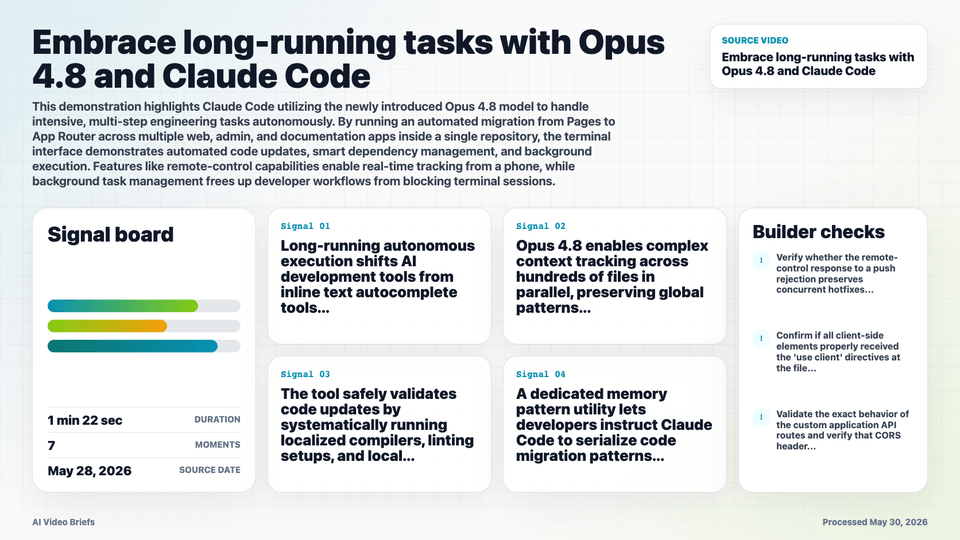
- Long-running autonomous execution shifts AI development tools from inline text autocomplete tools into background software engineering teammates.
- Opus 4.8 enables complex context tracking across hundreds of files in parallel, preserving global patterns and configurations during architectural changes.
- The tool safely validates code updates by systematically running localized compilers, linting setups, and local dev server checks automatically.
- A dedicated memory pattern utility lets developers instruct Claude Code to serialize code migration patterns and re-apply them across remaining project modules.
- The CLI actively coordinates multi-threaded sub-tasks, executing distinct shell commands for compilation, route verification, and type checking in parallel.
- The system handles terminal blockades like push rejections by generating options to force updates, fetch remote tracking, or apply contextual adjustments.
- Continuous summary readouts provide developers with explicit changesets, structural map tables, and verified response code statuses upon final delivery.
Builder Implications
- Configure your monorepos to ensure linting, Playwright end-to-end tests, and TypeScript compiler configurations run flawlessly in single commands to enable smooth Claude Code execution.
- Leverage the `/remote-control` switch to delegate massive refactoring epics to the background, preventing your primary machine from running into blocking terminal threads.
- Utilize the built-in memory pattern caching to efficiently scale systematic codebase changes from a single directory out to large-scale micro-frontends.
- Structure individual application route folders logically so that background agents can confidently resolve client components and server actions without breaking structural dependencies.
- Review the auto-generated summary tables at the conclusion of tasks to manually audit API responses and route handler edge cases before closing PRs.
Things to Verify
- Verify whether the remote-control response to a push rejection preserves concurrent hotfixes or requires a safer branch/rebase policy.
- Confirm if all client-side elements properly received the 'use client' directives at the file boundaries during the automated App Router transformation.
- Validate the exact behavior of the custom application API routes and verify that CORS header configurations were carried over without security drops.
- Check the serialized memory file structure to see where Claude Code stores migration blueprints to manually edit custom rules if necessary.