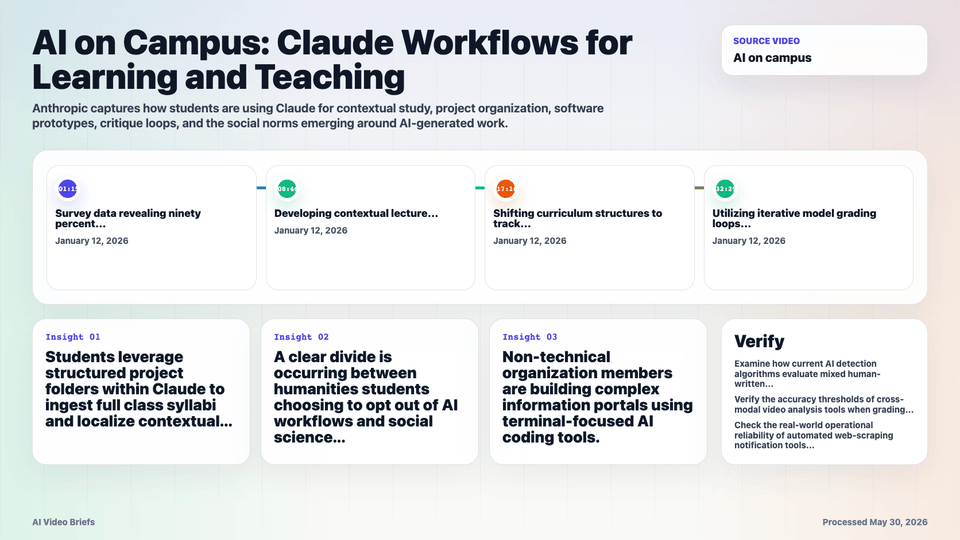
Executive Summary
University students discuss the transformation of academic environments through intentional Claude prompting, custom project setups, and the shifting dynamics of technical skill access.
Over ninety percent of students utilize generative conversational models to process abstract material, structure lecture insights, and prototype local apps.
Academic institutions are slowly moving away from flat text generation prohibitions toward tracking explicit interactive prompt conversation logs.
The barrier to producing operational software prototypes has dropped to days, enabling non-technical students to execute complex terminal-based applications.
Key Takeaways
- Students leverage structured project folders within Claude to ingest full class syllabi and localize contextual exam adjustments.
- A clear divide is occurring between humanities students choosing to opt out of AI workflows and social science majors slowly embracing them.
- Non-technical organization members are building complex information portals using terminal-focused AI coding tools.
- Group project dynamics are heavily undermined when individuals copy verbatim generic model responses without human iteration.
- Students actively use specific model personas to simulate real-world critical grading loops before formal assignments are submitted.
- Corporate recruitment processes are increasingly moving toward automated candidate video screenings and screening engines.
- The emergence of generic AI speech patterns has led to social conventions around identifying unedited semantic models as 'slop'.
Builder Implications
- Incorporate strict tone and voice custom constraints inside application styling profiles to bypass recognizable generic language output.
- Build integrated citation logging architectures so users can track the specific input documents that informed an agentic summary.
- Focus product onboarding on high-agency users who utilize iterative prompting cycles rather than single-turn search replacement patterns.
- Design systems with robust text compaction modes to optimize performance when users manage extended hundreds-of-turn threads.
- Construct interactive evaluation tools that allow builders to test software against diverse and strict reviewer persona constraints.
Things to Verify
- Examine how current AI detection algorithms evaluate mixed human-written and model-structured engineering outputs.
- Verify the accuracy thresholds of cross-modal video analysis tools when grading unstructured presentation clips.
- Check the real-world operational reliability of automated web-scraping notification tools built entirely by non-developers.
- Assess the performance variance between Sonnet and Opus versions when evaluating long-form multi-file contextual prompts.