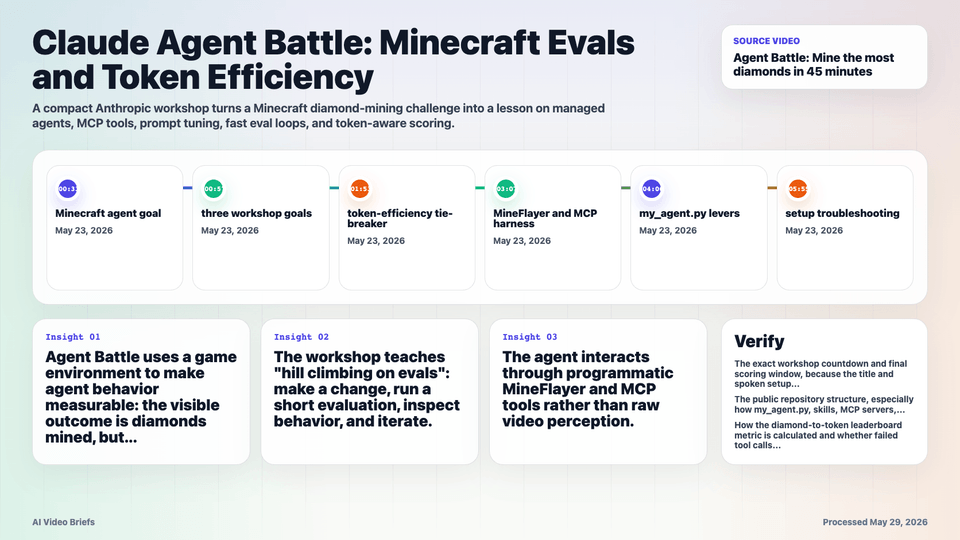
Executive Summary
Anthropic's Applied AI team frames Agent Battle as a hands-on way to learn agent optimization. Participants configure a Claude-powered agent in a Minecraft-like diamond-mining challenge, then improve its behavior through prompts, model choices, skills, and MCP-connected tools rather than relying on visual gameplay input.
The useful builder lesson is the eval loop. The video emphasizes fast development runs, a constrained final scoring run, and a leaderboard that values both diamonds mined and token efficiency. That changes the optimization target from "use a bigger model" to "make the agent spend context and tool calls on actions that move the task forward."
The technical harness uses MineFlayer and Model Context Protocol servers to expose game actions as programmatic tools. The editable surface is intentionally small: the system prompt, selected model, custom skills in my_agent.py, and the agent's evaluation cycle. Gemini also flagged a timing ambiguity between the video title and a spoken workshop countdown, so this brief treats the exercise structure as the reliable takeaway rather than the exact workshop clock.
Key Takeaways
- Agent Battle uses a game environment to make agent behavior measurable: the visible outcome is diamonds mined, but the engineering target is repeatable improvement.
- The workshop teaches "hill climbing on evals": make a change, run a short evaluation, inspect behavior, and iterate.
- The agent interacts through programmatic MineFlayer and MCP tools rather than raw video perception.
- The main tuning levers are the system prompt, model string, custom skills, and tool usage strategy.
- Token efficiency is part of the score, so a verbose or overpowered agent can lose to a smaller but more focused configuration.
- Short development evals are used to keep iteration fast before spending time on a full scoring run.
Builder Implications
- Define an eval metric that captures task output and resource use before optimizing an agent.
- Prefer small, fast eval subsets during development so prompt and skill changes can be compared quickly.
- Expose structured tools through MCP when the environment already has a reliable programmatic interface.
- Treat model selection as one lever among several; prompt shape, skill code, and tool discipline often matter more.
- Design leaderboards and acceptance tests so they reward efficient success, not just maximum action volume.
Things to Verify
- The exact workshop countdown and final scoring window, because the title and spoken setup appear to use different time references.
- The public repository structure, especially how my_agent.py, skills, MCP servers, and evaluation scripts are wired together.
- How the diamond-to-token leaderboard metric is calculated and whether failed tool calls count against the agent.
- What changes are allowed in a real competition run versus a local practice run.